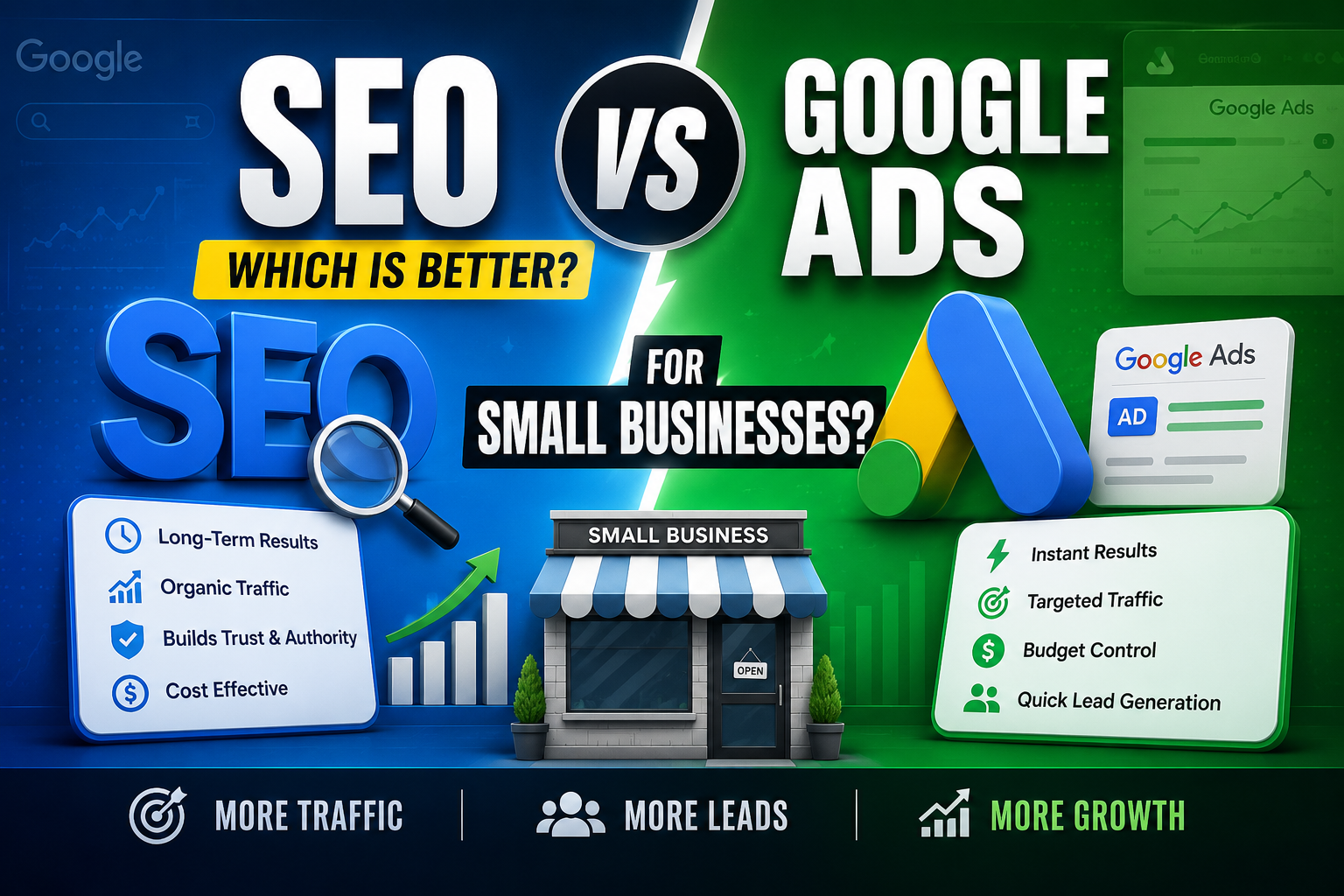
For small businesses trying to attract more customers online, one question comes up repeatedly: SEO vs Google Ads—which is better?
Both strategies can help your business appear on Google, attract potential customers and generate leads. However, they work differently, require different investments and produce results on different timelines.
Google Ads can place your business in front of potential customers almost immediately, while search engine optimization focuses on earning long-term organic visibility. The right choice depends on your budget, competition, business goals and how quickly you need results.
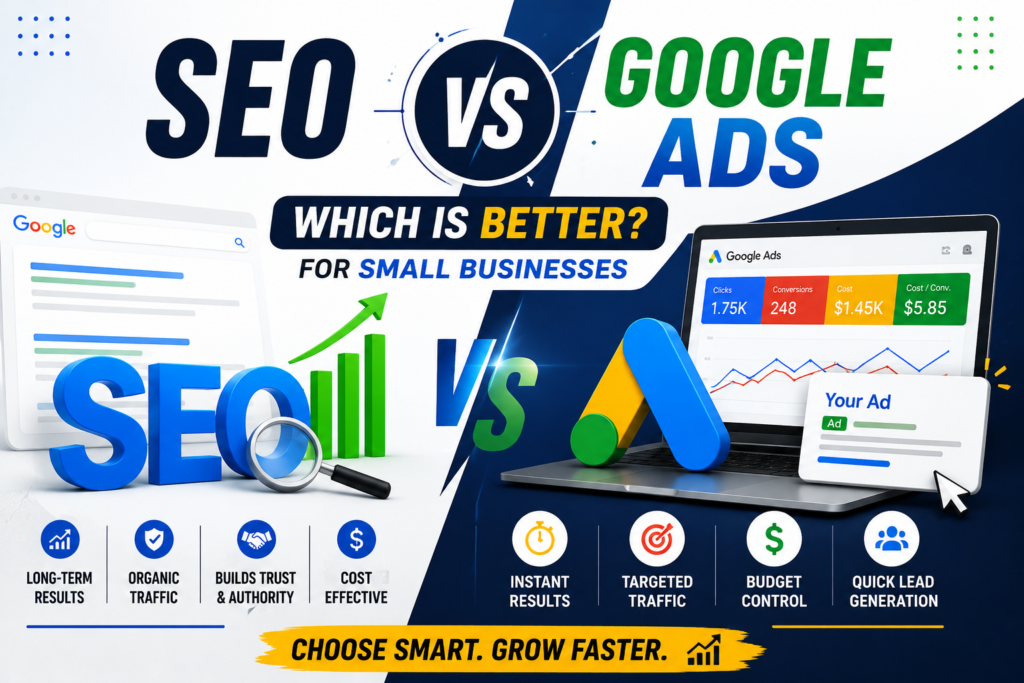
For most small businesses, the best strategy is not choosing one and completely ignoring the other. The strongest approach is often to use Google Ads for immediate visibility while building SEO as a sustainable, long-term customer acquisition channel.
This guide compares SEO vs Google Ads for small businesses, including their costs, benefits, limitations and ideal use cases.
What Is SEO?
Search engine optimization, commonly known as SEO, is the process of improving your website so it can rank higher in Google’s unpaid search results.
When someone searches for a service such as “SEO company near me,” “website developer in Lahore” or “best digital marketing agency,” Google analyzes available webpages and displays the results it considers most useful and relevant.
SEO involves improving several parts of a website, including:
- Website content
- Keyword targeting
- Page titles and headings
- Internal linking
- Technical performance
- Mobile responsiveness
- Website speed
- Backlinks
- Local business signals
- User experience
Unlike advertising, businesses do not pay Google every time someone clicks an organic result. However, SEO still requires investment in content creation, technical improvements, strategy, link building and ongoing optimization.
Google’s current guidance emphasizes helpful, original and people-first content rather than pages created mainly to manipulate rankings. The same foundational SEO practices also apply to visibility in Google AI Overviews and AI Mode.
What Are Google Ads?
Google Ads is Google’s paid advertising platform. It allows businesses to display advertisements across Google Search, Google Maps, YouTube and other partner websites.
With Google Search Ads, businesses can bid on keywords related to their products or services. For example, a plumbing company may run an advertisement for the keyword “emergency plumber near me.”
When a user searches for that keyword, the company’s advertisement may appear at the top of the search results.
In most search campaigns, advertisers pay when someone clicks their advertisement. This model is known as pay-per-click advertising or PPC.
Google Ads campaigns can target users by:
- Search keywords
- Geographic location
- Device
- Time of day
- Audience characteristics
- Previous website activity
- Customer interests
- Search intent
Modern Google Ads campaigns increasingly use machine learning to optimize targeting, bidding and ad combinations. Features such as responsive search ads and AI-powered campaign tools can test different messages and identify combinations likely to produce better results.
SEO vs Google Ads: The Main Difference
The main difference between SEO and Google Ads is how businesses gain visibility.
With SEO, you improve your website to earn a position in Google’s organic results.
With Google Ads, you pay to compete for advertising placements.
Here is a simple comparison:
| Factor | SEO | Google Ads |
|---|---|---|
| Traffic type | Organic traffic | Paid traffic |
| Speed of results | Usually gradual | Potentially immediate |
| Cost per click | No direct payment to Google | Advertiser pays for clicks |
| Long-term value | Can continue generating traffic | Traffic stops when ads stop |
| Testing capability | Slower | Fast campaign testing |
| Best use | Long-term growth | Immediate leads and promotions |
| Trust level | Often perceived as more credible | Clearly marked as sponsored |
| Control | Limited ranking control | Strong targeting and budget control |
Neither strategy guarantees results. SEO depends on content quality, competition, website authority and technical performance. Google Ads depends on targeting, bidding, landing-page quality, ad relevance, conversion tracking and budget.
Benefits of SEO for Small Businesses
1. SEO Can Produce Long-Term Traffic
One of the biggest advantages of SEO is its long-term value.
A well-optimized page can continue attracting visitors for months or even years. You may need to update the page and maintain its quality, but you do not have to pay Google for every organic click.
For example, a service page ranking for “website development company in Lahore” could attract potential clients whenever people search for that service.
This makes SEO valuable for businesses that want to reduce their dependence on paid advertising over time.
2. Organic Rankings Can Build Trust
Many users trust organic results because those pages have earned their visibility rather than paying for every placement.
Appearing prominently in organic search can improve:
- Brand authority
- Business credibility
- Customer confidence
- Website engagement
- Recognition within your industry
Publishing useful educational content can also position your company as a knowledgeable resource.
For example, businesses interested in modern marketing technology may benefit from reading about the top AI tools in 2026.
3. SEO Supports Multiple Stages of the Customer Journey
SEO does not only target people who are ready to buy immediately.
It can also reach users who are:
- Researching a problem
- Comparing service providers
- Learning about available solutions
- Evaluating costs
- Looking for reviews
- Searching for a local company
A customer may first discover your educational blog, return later to view your services and contact you when ready.
This creates multiple opportunities to build trust before the final conversion.
4. SEO Can Improve Website Quality
Successful SEO requires more than adding keywords.
Businesses often need to improve:
- Page structure
- Navigation
- Mobile performance
- Loading speed
- Content clarity
- Internal links
- Calls to action
- Technical accessibility
These improvements can create a better experience for both search engines and potential customers.
5. SEO Results Can Compound Over Time
Every optimized service page, blog post, case study and backlink can contribute to the overall authority of your website.
As the website grows, newer pages may rank more easily because they benefit from the site’s existing authority and internal linking structure.
A practical example can be seen in this SEO success story focused on organic traffic and leads.
Limitations of SEO
SEO offers strong long-term potential, but small businesses should understand its limitations.
SEO Takes Time
A new website usually cannot expect to rank for competitive keywords immediately.
Depending on the market, existing authority and competition, meaningful progress may take several months. Google also explains that improvements can take days or several months to be reflected across its systems.
Rankings Are Not Guaranteed
No SEO company can honestly guarantee a permanent number-one ranking.
Google uses automated ranking systems and regularly evaluates content quality, relevance, originality and user value. Competitors may also improve their websites.
SEO Requires Consistency
Publishing one article and waiting is usually not enough.
SEO requires ongoing work, including:
- Updating old content
- Publishing useful resources
- Fixing technical issues
- Improving important service pages
- Building relevant backlinks
- Monitoring rankings
- Analyzing search queries
- Strengthening internal links
Benefits of Google Ads for Small Businesses
1. Google Ads Can Generate Immediate Visibility
SEO may require time, but a properly configured Google Ads campaign can begin receiving impressions and clicks shortly after approval.
This makes Google Ads useful for:
- New businesses
- Product launches
- Limited-time offers
- Seasonal services
- Urgent lead generation
- Testing a new market
A small business that cannot wait several months for organic rankings may use paid search to reach potential customers immediately.
2. Businesses Can Target High-Intent Keywords
Google Ads allows businesses to target users who are actively searching for a service.
For example, someone searching for “emergency AC repair near me” may be ready to contact a company immediately.
This is different from showing advertisements to people who may not currently need the service.
High-intent targeting can make Google Search Ads especially effective for:
- Local services
- Legal services
- Healthcare providers
- Home repair companies
- Business-to-business services
- Ecommerce products
- Professional consultants
3. Google Ads Offers Strong Budget Control
Businesses can set:
- Daily budgets
- Campaign budgets
- Maximum bids
- Geographic locations
- Advertising schedules
- Device targeting
- Keyword targeting
You can increase spending when a campaign performs well or pause campaigns when necessary.
However, increasing the budget alone does not guarantee better results. Campaign performance still depends on targeting, landing pages, tracking, offers and overall strategy.
4. Campaign Results Are Easier to Measure Quickly
With proper conversion tracking, Google Ads can show:
- Clicks
- Impressions
- Click-through rate
- Cost per click
- Form submissions
- Phone calls
- Purchases
- Cost per lead
- Return on ad spend
This makes it easier to test different keywords, offers and landing pages.
The data collected from paid campaigns can also support SEO strategy. For instance, keywords producing high-quality paid leads may deserve dedicated organic landing pages.
5. Google Ads Can Support Local Visibility
Local businesses can use Google Ads to appear in location-based searches and, where eligible and properly connected, relevant placements on Google Maps.
This can help companies reach users searching within specific cities or service areas. Paid local placements are separate from a business’s organic Google Maps visibility.
Limitations of Google Ads
Advertising Costs Can Increase
Popular commercial keywords can become expensive, especially in competitive industries.
Businesses may compete with companies that have larger budgets, stronger landing pages and experienced campaign managers.
Traffic Stops When the Budget Stops
Google Ads traffic depends on active advertising spend.
Once a campaign is paused or the budget is exhausted, paid visibility can disappear immediately.
This is why relying entirely on paid advertising can become risky for small businesses.
Poor Campaign Setup Can Waste Money
Google Ads is not simply a matter of selecting keywords and adding money.
A campaign may underperform because of:
- Broad or irrelevant targeting
- Weak ad copy
- Missing negative keywords
- Poor conversion tracking
- Slow landing pages
- Unclear offers
- Wrong location settings
- Low-quality leads
- Ineffective bidding
- Weak follow-up processes
Professional campaign management can help businesses avoid these issues.
SEO vs Google Ads: Which Is More Cost-Effective?
SEO is often more cost-effective over the long term because organic traffic does not carry a direct cost for every click.
However, SEO requires upfront and ongoing investment.
Google Ads may be more expensive per visitor, but it can generate faster data, traffic and leads.
The more cost-effective option depends on:
- Your average sale value
- Customer lifetime value
- Profit margin
- Conversion rate
- Keyword competition
- Advertising costs
- SEO competition
- Campaign management quality
For example, paying $20 for a click may be reasonable if one customer produces thousands of dollars in revenue. The same cost may be unsustainable for a low-margin product.
Businesses should calculate results based on revenue and qualified leads rather than traffic alone.
Is SEO Better Than Google Ads?
SEO may be better when your business:
- Wants sustainable long-term traffic
- Has time to build rankings
- Wants to strengthen brand authority
- Can consistently publish useful content
- Operates in an industry with valuable informational searches
- Wants to reduce dependence on paid traffic
- Has an established website that can be improved
SEO is especially valuable when users research extensively before choosing a provider.
A company can publish guides, comparisons, FAQs, case studies and service pages that answer questions throughout the customer journey.
Are Google Ads Better Than SEO?
Google Ads may be better when your business:
- Needs leads quickly
- Is launching a new product or service
- Wants to test a new offer
- Has a measurable conversion funnel
- Operates in a high-intent market
- Has a strong landing page
- Can afford a consistent advertising budget
- Needs visibility while SEO is developing
Google Ads can also help determine whether a keyword produces customers before investing months into organic optimization.
Should Small Businesses Use SEO and Google Ads Together?
For many small businesses, using SEO and Google Ads together produces the strongest strategy.
Google Ads can provide short-term visibility, while SEO builds long-term organic growth.
A combined strategy may work like this:
- Launch Google Ads for high-intent keywords.
- Track which keywords generate qualified leads.
- Create SEO service pages around proven keywords.
- Publish supporting informational content.
- Improve landing pages using advertising data.
- Build organic rankings over time.
- Reduce dependence on expensive keywords when organic visibility improves.
- Continue advertising for profitable terms and important promotions.
This approach gives the business both speed and stability.
It also prevents the company from relying entirely on a single marketing channel.
How AI Is Changing SEO and Google Ads
Artificial intelligence is influencing both organic search and paid advertising.
In SEO, Google can use AI systems to understand content, queries and context more effectively. Businesses therefore need to create clear, useful and original content that answers real customer questions.
Google states that no special markup or secret optimization is required solely for AI Overviews or AI Mode. Strong technical SEO, crawlable links and valuable content remain the foundation.
To improve visibility in traditional and AI-powered search experiences, content should include:
- A direct answer near the beginning
- Clear headings
- Original insights
- Real examples
- Expert input
- Relevant statistics
- Concise definitions
- Comparison tables
- Frequently asked questions
- Descriptive internal links
- Updated information
- Transparent business details
Businesses should avoid publishing hundreds of generic AI-generated pages without original value. Google warns that using generative AI to create content at scale without helping users may violate its spam policies.
In Google Ads, AI supports automated bidding, audience analysis, creative combinations and query matching. However, automation still needs accurate conversion tracking, quality creative assets and human oversight.
How to Choose the Right Strategy
Ask these questions before deciding between SEO and Google Ads:
How Quickly Do You Need Leads?
Choose Google Ads when immediate visibility is essential.
Choose SEO when you can invest in gradual, sustainable growth.
What Is Your Budget?
Google Ads requires ongoing media spend in addition to campaign management.
SEO requires investment in strategy, content, technical optimization and authority building.
How Competitive Is Your Industry?
Highly competitive keywords may be expensive in both paid and organic search.
A keyword analysis can determine which opportunities are realistic.
Is Your Website Ready to Convert Traffic?
Neither SEO nor Google Ads will perform well if your website has:
- Confusing navigation
- Slow loading times
- Weak service explanations
- No clear call to action
- Poor mobile usability
- Missing trust signals
- Complicated contact forms
Before investing heavily in traffic, make sure the website can convert visitors into leads.
Do You Have Reliable Tracking?
Set up analytics, conversion tracking, call tracking and form tracking.
Without reliable data, it becomes difficult to determine which channel is generating real business results.
Final Verdict: SEO vs Google Ads
So, SEO vs Google Ads—which is better for small businesses?
Google Ads is generally better for immediate visibility, fast testing and short-term lead generation.
SEO is generally better for long-term organic traffic, authority and sustainable customer acquisition.
However, the best option for many small businesses is a combined strategy.
Use Google Ads to reach high-intent customers today while investing in SEO to build an organic asset that becomes more valuable over time.
The final decision should not be based only on clicks or rankings. It should be based on qualified leads, customer acquisition costs, revenue and long-term profitability.
Businesses that need a tailored SEO and advertising strategy can learn more about Marketo Solutions, explore the Marketo Solutions digital marketing services or contact the team for a consultation.
Professionals who want to develop practical skills in this field can also explore opportunities and guidance related to digital marketing jobs.
Frequently Asked Questions
Is SEO cheaper than Google Ads?
SEO can be more cost-effective over the long term because businesses do not pay Google for every organic click. However, SEO still requires investment in content, technical improvements and ongoing optimization.
How long does SEO take to work?
SEO may take several months to produce significant results, depending on competition, website authority, technical condition and content quality.
How quickly can Google Ads generate leads?
A campaign can begin receiving traffic soon after it is approved. However, generating profitable leads depends on targeting, budget, ad quality, landing pages and conversion tracking.
Does running Google Ads improve SEO rankings?
Paying for Google Ads does not directly improve organic rankings. Paid and organic search are separate systems. Advertising can produce useful keyword and conversion data, but it does not purchase an organic position.
Should a new business start with SEO or Google Ads?
A new business can use Google Ads for immediate traffic while starting SEO at the same time. This provides short-term visibility and begins building long-term organic authority.
Can a small business manage SEO and Google Ads itself?
A business owner can learn the basics, but both channels require continuous analysis and optimization. Professional support may be useful when budgets, competition or technical requirements become more complex.