Getting a website indexed on Google is easy, but turning that website into a consistent source of visibility, traffic, and qualified leads requires a proper SEO strategy.
In this SEO success story, we share how a focused search engine optimization campaign helped a client achieve 80,900 Google impressions and 1,560 organic clicks within three months. Along with improved search visibility, the client also started receiving more relevant business inquiries and better-quality leads.
This case study shows how technical improvements, keyword targeting, content optimization, and consistent SEO efforts can gradually turn a low-performing website into a valuable lead-generation asset.
SEO Campaign Results at a Glance
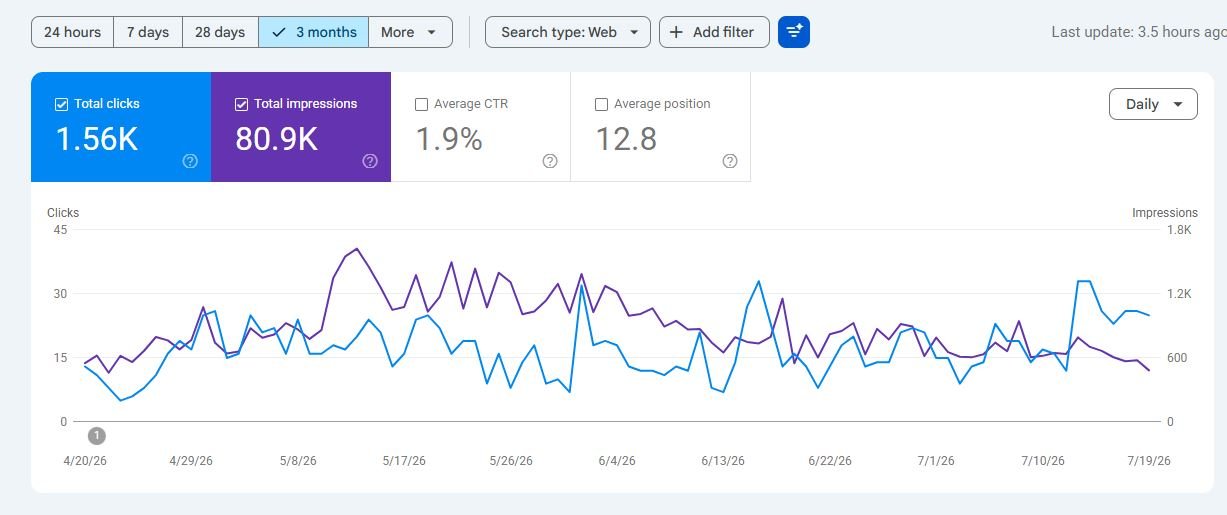
According to Google Search Console data for the last three months, the website achieved:
- 1.56K total organic clicks
- 80.9K total impressions
- 1.9% average click-through rate
- 12.8 average Google position
These numbers show that the website appeared in Google search results more than 80,000 times during the campaign period.
More importantly, the website did not only gain visibility. The client also reported receiving better-quality leads from people who were actively searching for the services offered by the business.
This is the real purpose of SEO: not just increasing numbers, but attracting potential customers with genuine buying intent.
The Client’s Initial SEO Challenges
Before the SEO work started, the website was not performing at its full potential.
Like many business websites, it had pages and services available online, but Google was not giving them enough visibility. The website needed a stronger structure, clearer keyword targeting, better optimization, and greater search engine authority.
Some of the common challenges included:
- Limited organic search visibility
- Weak keyword targeting
- Pages not properly optimized for user intent
- Low click-through opportunities
- Inconsistent rankings
- Lack of a structured content strategy
- Missed opportunities to generate leads from Google
- Technical and on-page SEO gaps
The business wanted more than website traffic. The primary goal was to reach people who were already searching for its services and convert that visibility into real inquiries.
Our Main SEO Objectives
The SEO campaign was designed around four main goals:
- Improve the website’s visibility in Google search results.
- Increase relevant organic traffic.
- Rank service-related keywords closer to the first page.
- Generate more qualified business leads.
Instead of targeting broad and irrelevant traffic, the strategy focused on keywords connected to the client’s actual services.
This helped ensure that the traffic coming to the website had a stronger chance of converting into phone calls, messages, bookings, or inquiries.
Step 1: Complete Website SEO Audit
The first step was to understand the website’s existing condition.
A detailed SEO audit was performed to identify the issues affecting rankings, user experience, crawling, and visibility.
The audit reviewed areas such as:
- Website structure
- Page titles and meta descriptions
- Heading tags
- Content quality
- Keyword placement
- Internal linking
- URL structure
- Image optimization
- Mobile usability
- Website speed
- Indexing
- Sitemap configuration
- Technical errors
- Search intent alignment
This audit created a clear roadmap for the campaign. Instead of making random changes, every SEO action was based on the website’s actual weaknesses and opportunities.
Step 2: Keyword Research Based on Search Intent
Keyword research played a major role in the growth of this website.
The focus was not simply on finding keywords with high search volume. We selected keywords based on relevance, competition, location, business value, and user intent.
The keyword strategy included:
- Primary service keywords
- Local search keywords
- Long-tail keywords
- Commercial-intent keywords
- Informational keywords
- Problem-based search queries
- Related service terms
For example, someone searching for general information may not be ready to buy. However, someone searching for a specific service, location, solution, or provider is much closer to making a decision.
By focusing on high-intent search terms, the campaign attracted users who were more likely to contact the business.
Step 3: On-Page SEO Optimization
Once the keywords were finalized, the important website pages were optimized.
On-page SEO helped Google understand what each page was about and which search queries it should rank for.
The optimization process included:
- Writing improved SEO titles
- Creating stronger meta descriptions
- Optimizing H1, H2, and H3 headings
- Adding primary and secondary keywords naturally
- Improving service-page content
- Removing unnecessary keyword repetition
- Improving content readability
- Adding relevant internal links
- Optimizing image alt text
- Strengthening calls to action
- Improving page-topic relevance
The content was written for users first and search engines second.
This was important because modern SEO is no longer about adding the same keyword repeatedly. Google prefers pages that clearly answer user questions, explain services, build trust, and provide a useful experience.
Step 4: Technical SEO Improvements
Technical SEO helps search engines crawl, understand, and index a website properly.
Even excellent content can struggle to rank if the website has serious technical problems.
The technical optimization work included:
- Checking indexing issues
- Reviewing the XML sitemap
- Improving crawl accessibility
- Fixing broken links
- Reviewing duplicate pages
- Improving mobile usability
- Optimizing page speed
- Reviewing URL structures
- Checking canonical tags
- Improving site architecture
- Resolving important technical errors
These improvements created a stronger foundation for long-term rankings.
A technically healthy website also provides a better user experience, which helps visitors stay longer and explore more pages.
Step 5: Content Optimization and Expansion
Content was another important part of the campaign.
Existing pages were improved, and content opportunities were identified based on what potential customers were searching for.
The content strategy focused on:
- Answering real customer questions
- Explaining services clearly
- Addressing common problems
- Targeting long-tail keywords
- Supporting main service pages
- Building topical authority
- Increasing internal linking opportunities
- Creating content useful for both Google Search and AI search tools
Each content piece was created around a clear search intent.
Instead of publishing random blogs, the goal was to build a connected group of pages around the client’s services and audience needs.
Step 6: Improving Internal Linking
Internal linking is often ignored, but it plays an important role in SEO.
Relevant internal links were added between service pages, supporting content, and important landing pages.
This helped:
- Google discover pages more easily
- Distribute authority across the website
- Improve navigation
- Keep users on the site longer
- Strengthen the relevance of service pages
- Guide visitors toward contact and conversion pages
A well-planned internal linking structure makes the website easier to understand for both users and search engines.
Step 7: Building Search Visibility Consistently
SEO growth usually does not happen overnight.
During the three-month campaign, the website gradually started appearing more frequently across relevant Google searches.
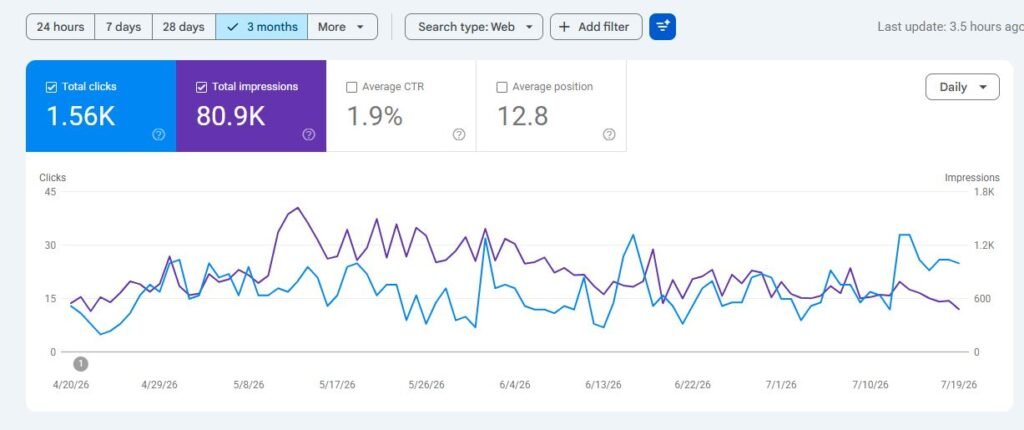
The Google Search Console graph shows consistent daily visibility, with impressions and clicks generated throughout the campaign period.
The website reached:
80.9K Total Impressions
This means the website appeared approximately 80,900 times in Google search results.
High impressions indicate that Google is increasingly recognizing the website as relevant for different search queries.
1.56K Organic Clicks
The website received approximately 1,560 clicks from organic Google search results.
These were unpaid visits. Unlike advertising traffic, the business did not need to pay for every individual click.
1.9% Average CTR
The average click-through rate was 1.9%.
CTR represents the percentage of impressions that resulted in a click. This figure can improve further through better titles, descriptions, rich results, and stronger rankings.
12.8 Average Position
The website achieved an average search position of 12.8.
This means many keywords were ranking close to the first page of Google, while some queries may already have reached first-page positions.
An average position close to page one creates a strong opportunity for future traffic growth.
How SEO Helped Generate Better Leads
The most valuable result of this campaign was not only improved traffic.
The client also reported receiving good-quality, relevant leads after the website gained stronger search visibility.
This happened because the campaign focused on commercial and service-related keywords rather than general traffic.
When a user searches for a specific service on Google, they usually have a clear need. They may be comparing providers, checking prices, looking for a local company, or preparing to contact a business.
By ranking for these search queries, the website reached potential customers at the right stage of their decision-making journey.
As a result, the client started receiving inquiries from users who were more closely matched to the business’s target audience.
This demonstrates the difference between ordinary website traffic and strategic SEO traffic.
Ordinary traffic increases visitor numbers. Strategic SEO traffic increases business opportunities.
Why This SEO Strategy Worked
The results came from combining multiple SEO activities rather than relying on a single tactic.
The campaign worked because it included:
- Detailed website analysis
- Search-intent-based keyword research
- Strong on-page optimization
- Technical SEO improvements
- Useful and relevant content
- Internal linking
- Consistent performance monitoring
- Focus on service-related traffic
- Continuous optimization
SEO becomes more effective when all parts of the website support each other.
Technical SEO helps Google access the website. Content helps Google understand it. Keywords connect the pages with search demand. Internal links strengthen relevance. Calls to action help convert visitors into leads.
What the Google Search Console Graph Tells Us
The three-month performance graph shows regular daily clicks and impressions.
Although daily performance naturally fluctuates, the website continued receiving organic visibility throughout the period.
There were several noticeable click peaks, showing days when the website attracted significantly more visitors from Google.
The graph also indicates that the site was not dependent on one isolated spike. It maintained a consistent level of search exposure, which is a positive sign for long-term SEO growth.
Toward the later part of the reporting period, clicks also showed strong daily performance on multiple days.
This suggests that the website had begun building sustainable organic visibility.
SEO Is a Long-Term Business Asset
Paid advertising can generate quick traffic, but the traffic normally stops when the budget stops.
SEO works differently.
A well-optimized website can continue generating visibility, traffic, and inquiries over time. Rankings may require ongoing improvement, but each optimized page becomes a long-term digital asset for the business.
This campaign produced 80.9K impressions and 1.56K clicks in three months, but it also created a foundation for future growth.
As more keywords move from the second page to the first page, the website has the potential to gain significantly more clicks without paying for each visit.
Opportunities for Further Growth
The website has already achieved promising results, but there are still opportunities to improve.
The next SEO phase can focus on:
- Moving high-impression keywords into the top 10
- Improving the 1.9% CTR
- Updating pages with high impressions but low clicks
- Creating additional service-based content
- Targeting more long-tail keywords
- Strengthening local SEO
- Improving conversion-focused landing pages
- Building more website authority
- Adding FAQs and structured data
- Improving calls to action
- Tracking form submissions and phone calls
Because the average position is 12.8, several keywords may be very close to the first page.
Even small ranking improvements can create a meaningful increase in organic clicks and leads.
Key Lessons from This SEO Success Story
This campaign offers several useful lessons for business owners.
Traffic Must Be Relevant
A website does not need millions of visitors to generate results. It needs visitors who are genuinely interested in its services.
Search Intent Matters
Keywords should match what potential customers are actually looking for.
SEO Requires a Complete Strategy
Keywords alone are not enough. Technical SEO, content, user experience, and internal linking must work together.
Consistency Produces Growth
Regular monitoring and optimization help maintain performance and uncover new opportunities.
Leads Are More Important Than Vanity Metrics
Impressions and clicks are valuable, but the real business success comes when search traffic generates calls, messages, appointments, and inquiries.
Conclusion
This SEO campaign helped the client achieve 80.9K Google impressions, 1.56K organic clicks, a 1.9% CTR, and an average position of 12.8 within three months.
The website gained stronger visibility across relevant searches and began attracting users with real interest in the client’s services.
Most importantly, the client reported receiving better and more relevant leads, showing that the SEO strategy was supporting actual business growth rather than only increasing traffic statistics.
This case study proves that when SEO is based on proper research, technical improvements, quality content, and user intent, it can become one of the most valuable long-term marketing channels for a business.
Want Similar SEO Results for Your Business?
Marketo Solutions helps businesses improve their Google rankings, increase organic traffic, strengthen online visibility, and generate more qualified leads.
Whether your website is new, not ranking properly, or receiving traffic without conversions, our team can create a customized SEO strategy based on your business goals.
Contact Marketo Solutions to start building long-term organic growth.
FAQs
How long did it take to achieve these SEO results?
The reported Google Search Console results cover a three-month period. During this time, the website generated 80.9K impressions and 1.56K organic clicks.
Did the SEO campaign generate leads?
According to the client’s feedback, the website started receiving better-quality and more relevant leads after its Google visibility improved.
What was the website’s average Google position?
The website achieved an average position of 12.8 during the reporting period, placing many keywords close to the first page.
What was the average click-through rate?
The website recorded an average organic CTR of 1.9%.
Can every website achieve the same SEO results?
SEO results depend on the website condition, industry, competition, location, authority, and campaign quality. However, a proper strategy can improve the visibility and lead-generation potential of most business websites.