
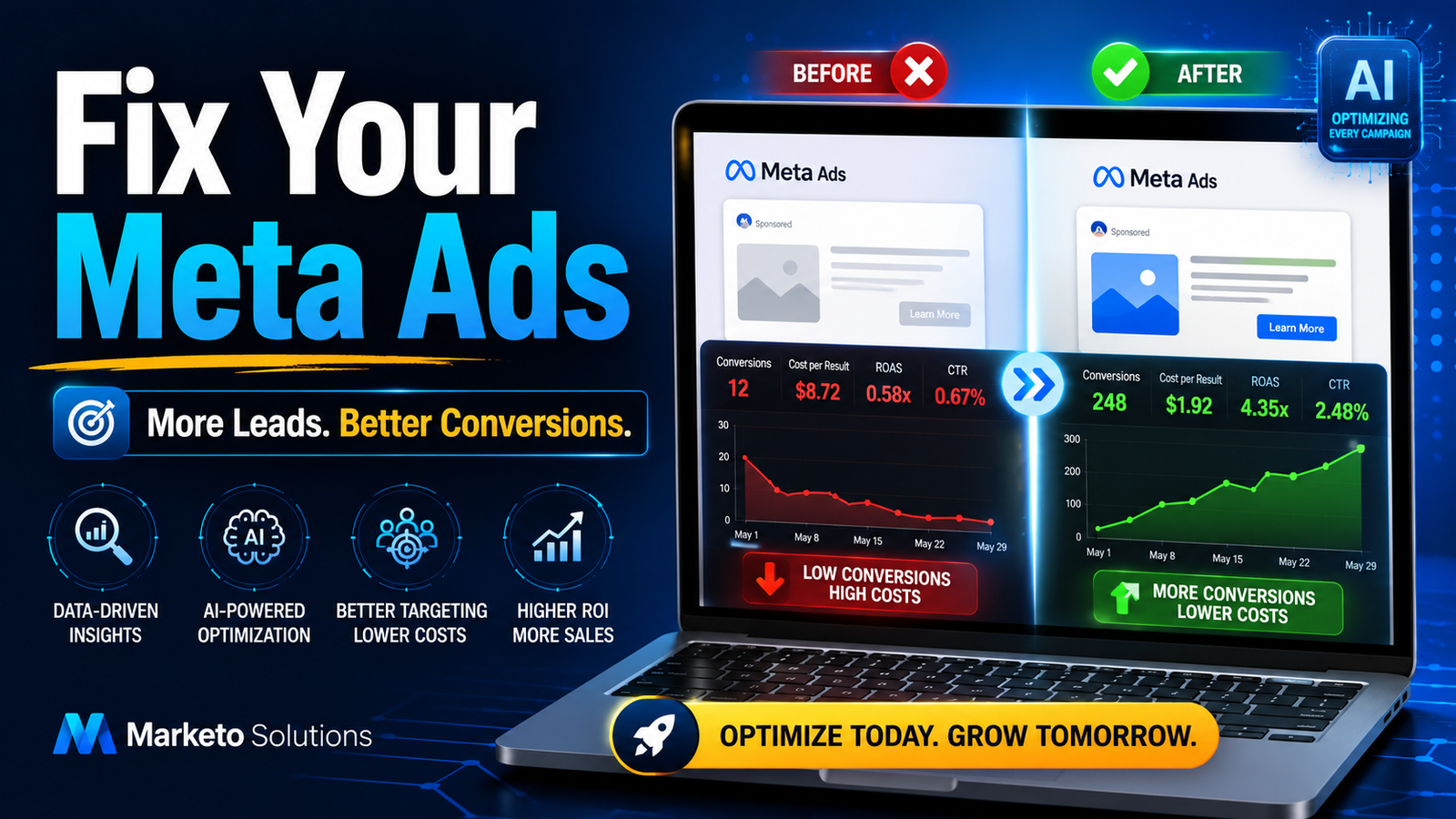
Facebook and Instagram ads are still powerful for generating leads, sales, bookings, and brand awareness. But many businesses face the same problem: ads are running, budget is being spent, people are clicking, but conversions are not happening.
The issue is not always Meta’s algorithm. In most cases, Facebook ads fail because of weak strategy, poor creative, wrong campaign objective, broken tracking, slow landing pages, unclear offers, or low-quality follow-up. In 2026, Meta advertising has become more AI-driven, which means the platform needs better data, better creatives, and clearer conversion signals to perform well.
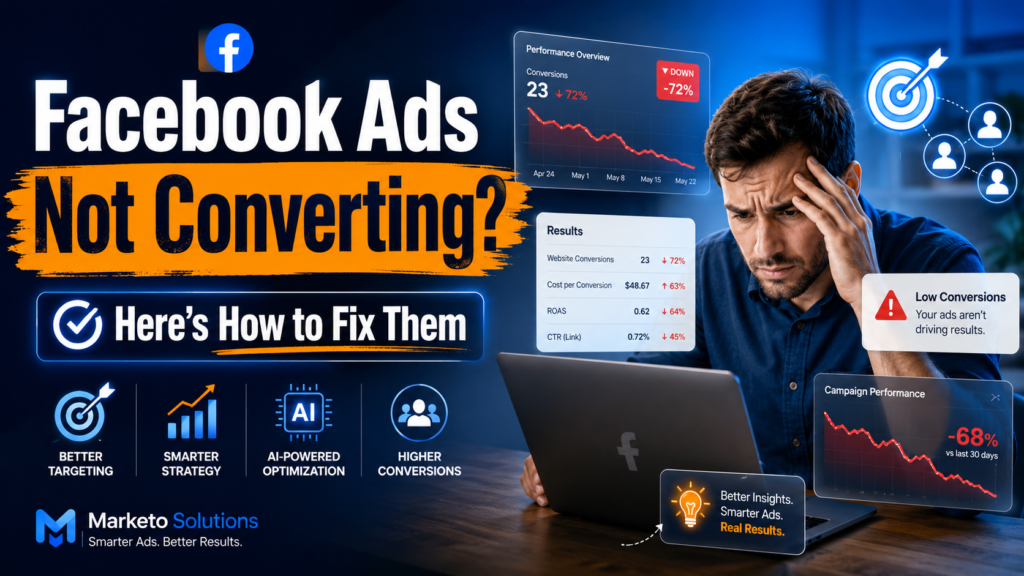
If your Facebook ads are not converting, this guide will help you understand the real reasons and practical fixes.
Why Are Your Facebook Ads Not Converting?
Your Facebook ads may not be converting because your campaign objective is wrong, your audience is too narrow, your creative is not strong enough, your landing page is slow or confusing, your offer is weak, your tracking is broken, or your sales follow-up is poor. To fix it, improve your ad creative, use the right objective, set up Pixel and Conversions API, test better offers, optimize your landing page, and track real business results instead of only clicks and impressions.
1. You Are Choosing the Wrong Campaign Objective
One of the most common reasons Facebook ads do not convert is choosing the wrong campaign objective.
Many businesses select traffic because it gives cheap clicks. But cheap clicks do not always mean quality leads or sales. If your goal is leads, WhatsApp inquiries, purchases, bookings, or form submissions, your campaign objective should match that goal.
For example, if you want people to submit a form, use a lead generation or conversions objective. If you want online purchases, optimize for purchases. If you want WhatsApp messages, use a messaging-focused campaign.
Meta’s algorithm learns from the objective you choose. If you ask it to find clickers, it will find clickers. If you ask it to find buyers or leads, it will try to find people more likely to take that action.
How to Fix It
Choose the objective based on your real business goal. Do not optimize only for traffic unless your goal is website visits. For leads, use lead campaigns, website conversion campaigns, or WhatsApp message campaigns. For ecommerce, optimize for add-to-cart, checkout, or purchase depending on your data volume.
2. Your Creative Is Not Stopping the Scroll
In 2026, creative is one of the biggest factors in Meta ad performance. Targeting is becoming more automated, and AI systems need multiple strong creative options to test and learn from.
If your ad looks like every other ad, people will ignore it. If the first three seconds of your video are weak, users will scroll away. If your image has too much text, unclear messaging, or no emotional hook, your ad will get attention but not action.
Good Facebook ad creative should answer three questions quickly:
What is the problem?
What is the solution?
Why should the user act now?
For example, instead of saying “Best Digital Marketing Services,” a stronger hook would be:
“Getting clicks but no leads? Your ad strategy may be wasting budget.”
This speaks directly to the pain point.
How to Fix It
Test at least 5 to 10 creative variations. Use short videos, reels-style content, carousel ads, testimonials, before-and-after results, offer-based graphics, and problem-solution hooks. Keep your message simple and clear. Make sure the visual matches the offer and audience.
3. Your Offer Is Not Strong Enough
Sometimes the ad is fine, but the offer is weak.
People do not convert just because they saw an ad. They convert because the offer feels useful, urgent, valuable, or low-risk. If your ad simply says “Contact us for services,” it may not be enough.
A better offer gives people a reason to act now. Examples include:
Free consultation
Free website audit
Free marketing strategy call
Limited-time discount
Free quote
Free trial
Free lead generation audit
Free Shopify store review
For service businesses, a free audit or consultation often works better than a direct “Buy now” message. For ecommerce, bundle deals, free delivery, limited discounts, or problem-solving product angles can improve conversions.
How to Fix It
Make your offer specific. Instead of “Get digital marketing services,” say “Get a free Meta Ads audit and discover why your ads are not converting.” Specific offers feel more valuable and generate better-quality inquiries.
4. Your Landing Page Is Losing Customers
Many businesses blame Facebook ads, but the real issue is the landing page.
A user clicks your ad because they are interested. But if your website loads slowly, looks unprofessional, has unclear content, or makes it difficult to contact you, they will leave.
A high-converting landing page should have:
A clear headline
Strong offer
Fast loading speed
Mobile-friendly design
Trust signals
Simple form
WhatsApp or call button
Testimonials or portfolio
Clear call-to-action
If your landing page does not match the ad promise, conversions will drop. For example, if your ad promotes “Free SEO Audit” but the landing page talks generally about all services, users may get confused and leave.
How to Fix It
Create a dedicated landing page for each main campaign. Keep the page focused on one offer. Use one clear CTA such as “Book Free Consultation,” “Get Free Audit,” or “WhatsApp Us.” Avoid sending paid traffic to a generic homepage unless the homepage is already optimized for conversions.
5. Your Tracking Is Broken or Incomplete
Meta ads need strong tracking data to optimize campaigns. If your Pixel is not installed properly, events are missing, or Conversions API is not configured, Meta may not understand which users are converting.
This can lead to poor optimization, inaccurate reporting, and wasted budget.
Common tracking problems include:
Pixel not firing
Purchase or lead event missing
Duplicate events
Wrong event priority
No Conversions API
No UTM tracking
No CRM or lead status tracking
WhatsApp leads not recorded properly
Without accurate tracking, you may think a campaign is not working when it is actually generating leads through calls, WhatsApp, or offline sales. Or you may think a campaign is working because it gets cheap leads, but those leads never become customers.
How to Fix It
Set up Meta Pixel, Conversions API, standard events, custom conversions, and UTM tracking. Track important actions such as page views, form submissions, phone clicks, WhatsApp clicks, add-to-cart, checkout, and purchases. For lead generation, also track lead quality, not just lead quantity.
6. Your Audience Is Too Narrow or Too Broad Without Strategy
Audience targeting is another reason Facebook ads fail.
If your audience is too narrow, Meta does not have enough room to optimize. If your audience is too broad without strong creative and clear messaging, your ads may reach people who are not ready to act.
In modern Meta ads, broad targeting can work well, but only when the campaign has strong creative, good tracking, and enough conversion data. For new businesses or small budgets, testing different audience types is still important.
Audience options may include:
Broad audience
Interest-based audience
Lookalike audience
Retargeting audience
Website visitors
Engaged Instagram/Facebook users
Past customers
Abandoned cart users
How to Fix It
Start with a simple structure. Test one broad audience, one interest-based audience, and one retargeting audience. Do not create too many ad sets with small budgets. Let Meta collect enough data before making major changes.
7. Your Campaign Is Stuck in Learning Limited
Meta needs enough conversion events to learn who is most likely to take action. If your ad set does not get enough events, performance can become unstable.
This often happens when the budget is too low, the audience is too small, the conversion event is too deep in the funnel, or there are too many ad sets splitting the budget.
For example, if you optimize for purchases but your store only gets a few purchases per week, Meta may struggle to learn. In that case, you may need to optimize for add-to-cart or initiate checkout first, then move to purchase once data improves.
How to Fix It
Consolidate your campaigns and avoid unnecessary ad sets. Increase budget only when needed and avoid making daily major edits. Choose a conversion event that gets enough volume. Let campaigns run long enough to collect data before judging results.
8. You Are Not Testing Enough Ad Angles
One ad cannot tell you everything. Many businesses create one image, one caption, one audience, and then stop the campaign after two days because it did not work.
That is not testing. That is guessing.
A good Meta ads strategy tests different angles. For example:
Problem-based angle
Price-based angle
Result-based angle
Testimonial angle
Comparison angle
Before-and-after angle
Urgency angle
Educational angle
Emotional angle
For a digital marketing agency, one ad angle could focus on “getting leads.” Another could focus on “wasted ad budget.” Another could focus on “website not converting.” Another could focus on “free audit.”
How to Fix It
Create a testing plan before launching ads. Test different hooks, creatives, captions, offers, and landing pages. After collecting data, scale the winning combinations and pause the weak ones.
9. Your Follow-Up System Is Weak
Facebook ads can generate leads, but your sales process converts them into customers.
If your team replies late, uses weak scripts, does not follow up, or fails to explain the offer properly, your campaign may look unsuccessful even when the ad is doing its job.
Lead generation businesses often lose money because they focus only on cost per lead, not cost per qualified lead or cost per customer.
A lead is not valuable unless it is contacted, qualified, nurtured, and converted.
How to Fix It
Reply to leads within minutes. Use WhatsApp automation, CRM tracking, call scripts, and follow-up reminders. Categorize leads as hot, warm, cold, fake, or converted. Measure which campaign brings real customers, not just cheap inquiries.
10. You Are Measuring the Wrong Metrics
Many advertisers focus on likes, impressions, reach, or clicks. These metrics are useful, but they do not always show business success.
For conversion campaigns, you should measure:
Cost per lead
Lead quality
Cost per purchase
Conversion rate
Return on ad spend
Cost per qualified lead
Landing page conversion rate
Sales closing rate
Customer acquisition cost
A campaign with expensive leads can still be profitable if those leads convert into high-value customers. A campaign with cheap leads can still be a failure if the leads are poor quality.
How to Fix It
Define your key performance indicators before launching the campaign. Track the full journey from ad click to final sale. Use Meta Ads Manager, Google Analytics, CRM data, and WhatsApp/call tracking where possible.
11. Your Brand Does Not Look Trustworthy
People do not buy from businesses they do not trust.
If your page has no reviews, no portfolio, weak branding, low-quality content, or inconsistent posting, users may hesitate to contact you. This is especially true for service businesses, real estate, clinics, ecommerce stores, and agencies.
Trust signals matter. Before converting, users may check your Facebook page, Instagram profile, website, reviews, comments, and previous work.
How to Fix It
Improve your social proof. Add testimonials, case studies, client logos, portfolio work, reviews, and clear contact details. Keep your Facebook and Instagram pages active. Make sure your website and social media look professional and consistent.
How Marketo Solutions Can Help
If your Facebook ads are spending budget but not producing leads or sales, Marketo Solutions can help you fix the full funnel.
Marketo Solutions provides digital marketing services including Meta Ads, Google Ads, SEO, Shopify and WordPress website development, landing pages, tracking setup, social media management, lead generation, reporting, and ROI optimization.
Instead of only running ads, Marketo focuses on the complete journey: ad strategy, creative testing, landing page optimization, lead tracking, reporting, and conversion improvement. This helps businesses understand where money is being wasted and how to turn ad traffic into real customers.
Whether you are a local business, ecommerce brand, real estate company, clinic, salon, service provider, or startup, Marketo Solutions can create a customized advertising strategy based on your goals and budget.
Final Thoughts
Facebook ads are not magic. They need the right strategy, strong creative, accurate tracking, good landing pages, and fast follow-up.
If your ads are not converting, do not immediately increase the budget. First, check your objective, creative, offer, landing page, Pixel, Conversions API, audience, learning phase, and sales process.
The businesses that win with Meta ads in 2026 are not just boosting posts. They are building complete conversion systems. They test creatives, track real results, improve offers, and optimize the full funnel.
If you want better leads, more sales, and improved return on ad spend, Marketo Solutions can help you audit your current campaigns and build a smarter Meta Ads strategy.
FAQs
1. Why are my Facebook ads getting clicks but no conversions?
Your ads may be attracting the wrong audience, using a weak offer, or sending traffic to a poor landing page. Clicks show interest, but conversions happen when the page, offer, trust signals, and CTA are strong enough.
2. How long should I run Facebook ads before judging results?
You should usually allow enough time for the campaign to collect data before making major decisions. Avoid judging performance too early, especially if the budget is low or the campaign is still learning.
3. What is better for leads: Facebook lead forms or landing pages?
Both can work. Facebook lead forms are faster and easier for users, but landing pages can provide more information and sometimes generate higher-quality leads. The best option depends on your business, offer, and follow-up process.
4. Do I need Meta Pixel and Conversions API?
Yes, if you want better tracking and optimization. Pixel tracks browser events, while Conversions API helps send server-side data. Using both can improve measurement and give Meta better signals for ad optimization.
5. How can Marketo Solutions improve my Facebook ads?
Marketo Solutions can audit your campaigns, fix tracking issues, improve ad creatives, create better landing pages, test offers, manage Meta Ads, and provide reporting focused on leads, sales, and ROI.