
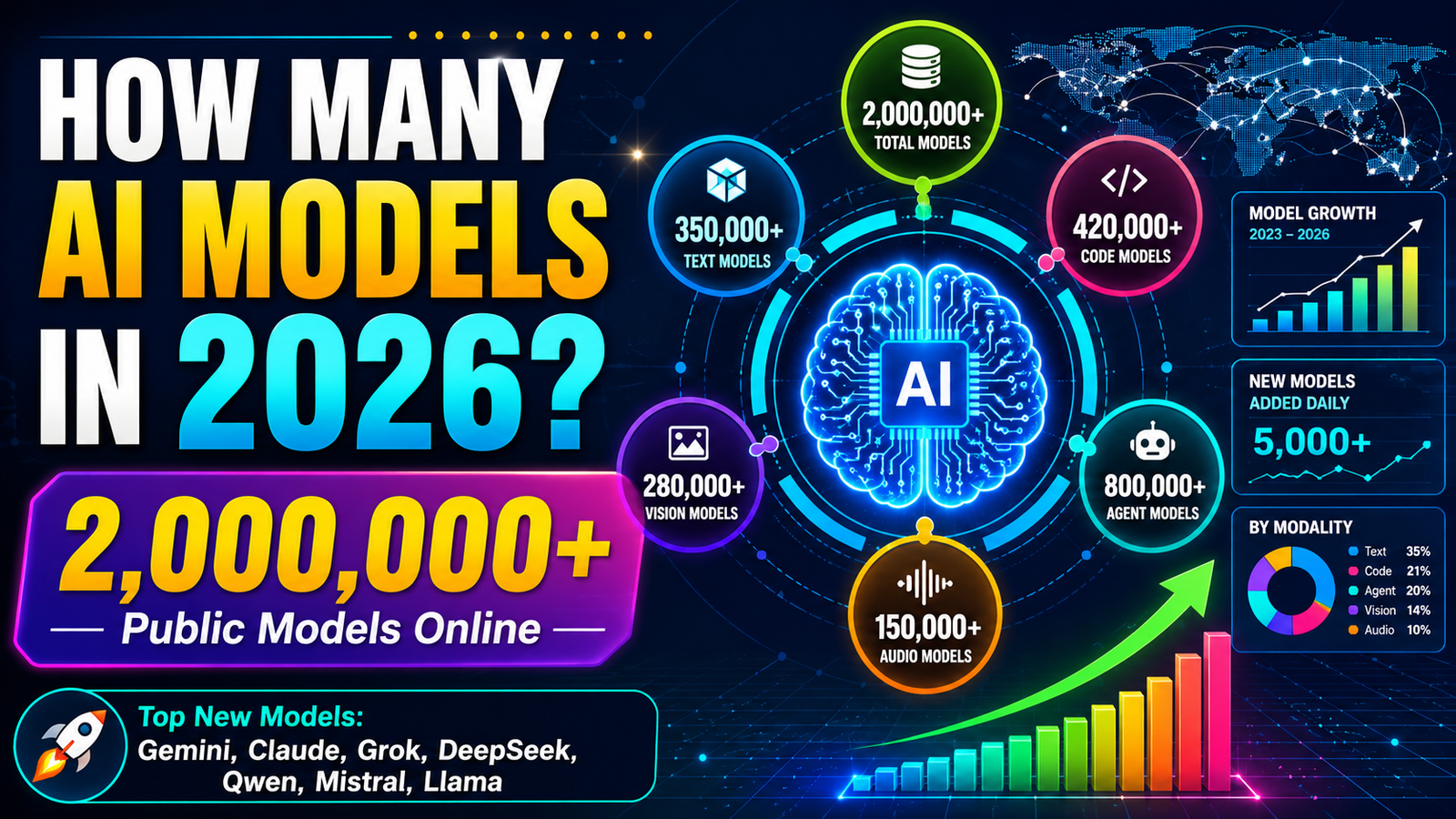
As of June 2026, there is no exact worldwide count of AI models. The safest evidence-based answer is that more than 2 million public AI model repositories are available online, with Hugging Face alone reporting over two million public models. When proprietary API models, cloud-only systems, private checkpoints and models hosted on other platforms are added, the real total is higher. However, no central registry tracks every model.
Why Is There No Exact Global Number?
AI models are published in many places. Some are downloadable from open-model hubs, while others are available only through APIs, mobile apps, enterprise clouds or research portals. Companies also update, rename and retire models frequently.
The term “AI model” can refer to:
- A new foundation model
- A fine-tuned version
- A quantized version for smaller hardware
- A task-specific adapter or LoRA
- A training checkpoint
- A commercial API model
- A private enterprise model
One estimate may count every repository and modified checkpoint, while another may count only original foundation-model families.
The Best Available AI Model Count in 2026
The strongest public benchmark comes from Hugging Face Models, the largest open AI model hub. Its 2026 ecosystem report says the platform had more than two million public models by the end of 2025.
That figure does not mean two million independent frontier systems. Many entries are fine-tunes, merged models, conversions, quantized files, language editions and models derived from popular families such as Qwen, Llama, Gemma, DeepSeek and Mistral.
The most accurate answer is:
More than two million public AI model repositories are available on the internet in 2026. The total number of public and proprietary models is higher, but an exact global count is unavailable.
This wording is more reliable for an AI Overview or featured snippet than an unsupported precise number.
What Does the Two-Million Figure Include?
The two-million figure counts public repositories, not model quality or completely original systems. It may include base models, fine-tunes, adapters, experimental uploads, duplicated formats and archived versions.
Some repositories contain complete model weights. Others provide only configuration files, adapters or files needed to modify and run another model.
The figure also excludes many systems available only through private APIs, enterprise contracts or internal company platforms. Therefore, the documented public count should be treated as a minimum.
Any estimate of the total number of internet-accessible models must separate verified public repositories from unverified proprietary and private systems.
How Many Unique Foundation Models Exist?
The number of genuinely distinct foundation-model families is far smaller than the repository count. There is no audited total, but it should be understood in thousands rather than millions.
A single foundation model may appear as:
- The original pretrained model
- An instruction-tuned edition
- A reasoning model
- A coding version
- Several parameter sizes
- Multiple quantized formats
- Hundreds of community fine-tunes
These versions can all be useful, but they are not separate foundation models.
Main Types of AI Models Available Online
The online AI ecosystem includes several major categories.
1. Large language models
Large language models generate text, answer questions, summarize documents, write code, perform reasoning and power AI agents.
2. Multimodal models
Multimodal models can process multiple forms of information, including text, images, audio and video.
3. Image models
Image models generate, edit, restore or transform images. They are widely used in advertising, product design, architecture and entertainment.
4. Video models
Video models create clips, animate images, extend footage, add synchronized audio or edit existing videos.
5. Speech and audio models
This category includes speech recognition, text-to-speech, voice generation, sound effects and music-generation systems.
6. Embedding and reranking models
Embedding and reranking models support search engines, recommendation systems, document matching and retrieval-augmented generation.
7. Computer-vision models
Computer-vision models handle classification, object detection, segmentation, optical character recognition and tracking.
8. Specialized models
Specialized AI models are developed for science, medicine, law, finance, cybersecurity, robotics, weather forecasting and manufacturing.
Latest and Trending AI Models to Know in 2026
The following are notable current models and model families. This is not a permanent performance ranking because pricing, benchmarks and availability change regularly.
1. GPT-5.5 Instant
GPT-5.5 Instant is a fast, general-purpose model with improved accuracy and instruction following.
It represents the movement toward systems that combine strong reasoning and language performance with lower latency for everyday and professional tasks.
2. Claude Opus 4.8
Claude Opus 4.8 is designed for complex professional work, software development and agentic workflows.
It is one of Anthropic’s leading high-capability models for long, multi-step tasks.
3. Gemini 3.1 Pro and Gemini 3.5 Flash
Gemini 3.1 Pro targets demanding reasoning, research and multimodal tasks.
Gemini 3.5 Flash focuses on faster agent-based applications and broad developer deployment.
4. Grok 4.3
Grok 4.3 is xAI’s flagship model for reasoning, instruction following, tool calling and enterprise AI agents.
It can be integrated into applications requiring multi-step task execution and access to external tools.
5. DeepSeek V4-Pro and V4-Flash
DeepSeek V4 combines long-context processing with coding, reasoning and agentic capabilities.
V4-Flash targets higher speed and throughput, while V4-Pro is designed for more demanding tasks.
6. Qwen 3.6 Plus
Qwen 3.6 Plus extends Alibaba’s Qwen ecosystem for coding, autonomous agents and multilingual applications.
Qwen also supports one of the largest communities of fine-tuned and derived open models.
7. Mistral Medium 3.5 and Mistral Small 4
Mistral Medium 3.5 focuses on multimodal, coding and agentic workloads.
Mistral Small 4 is a more efficient open model combining instruction following, reasoning and coding capabilities.
8. Gemma 4
Gemma 4 is Google’s current open-model family for local and cloud deployment.
The family includes models developed for agentic reasoning, multimodal inputs and operation on developer hardware.
9. Command A+
Command A+ is Cohere’s open enterprise model for multilingual, multimodal and agentic workloads.
It targets organizations that need private, controlled or sovereign AI deployment.
10. NVIDIA Nemotron 3 Ultra
NVIDIA Nemotron 3 Ultra is an open reasoning model designed for long-running agents and enterprise workflows.
It is optimized for deployment using NVIDIA’s AI infrastructure.
Llama 4 also remains an important open-weight model family in 2026, despite the arrival of newer commercial and community releases.
Why Does the Number of AI Models Keep Growing?
Creating a useful model variant is easier and less expensive than training a frontier model from scratch.
Developers can fine-tune an existing model, compress it, adapt it to another language, connect it to tools or optimize it for a particular device.
One successful open-weight model can generate thousands of community versions. Automated training pipelines and lower inference costs also allow smaller teams to publish narrow, task-specific models.
However, more uploads do not always mean greater diversity. Many new repositories are closely related to existing models.
For developers and businesses, model quality, licensing, safety, context length, latency, cost and deployment requirements matter more than the total model count.
Public, Open-Weight and Proprietary Models
These terms do not have the same meaning.
Public models can be discovered or accessed online.
Open-weight models provide downloadable trained weights, although their licences may still impose restrictions.
Open-source models should provide adequate code, documentation and permissions for inspection, modification and redistribution.
Proprietary models are normally accessed through an API or hosted product while their weights, source code and training data remain private.
A model can therefore be available on the internet without being downloadable.
How to Choose the Right AI Model
Choose an AI model according to the task rather than popularity alone.
For reasoning, compare accuracy, context window and tool-use capabilities. For coding, test the model against your own repositories and development workflow.
For enterprise search, review retrieval quality, citations and data controls. For local deployment, check memory requirements, quantization support and licence terms.
For image, audio or video tasks, compare output consistency, editing controls, processing speed and commercial-use rights.
The best AI model is the one that reaches the required quality at an acceptable cost, speed and risk level.
Final Answer
In 2026, at least two million public AI model repositories are available online, based on the largest documented model hub.
The internet-wide total is higher because many commercial, private and cloud-hosted models are not included in that figure.
However, this does not mean there are two million unique frontier models. Most repositories contain fine-tunes, checkpoints, adapters, compressed versions or task-specific derivatives.
The clearest answer is:
More than two million public AI models are available online in 2026, while the complete global total remains unknown and continues to grow.
Frequently Asked Questions
1. How many AI models are available on the internet in 2026?
More than two million public AI model repositories are available online. The total is higher when proprietary APIs and models outside major public hubs are included, but no organization maintains an exact global count.
2. What are the most popular AI models in 2026?
Popularity depends on the task and measurement method. Leading families include GPT-5.5, Claude 4.8, Gemini 3, Grok 4, DeepSeek V4, Qwen 3.6, Gemma 4, Mistral and Nemotron 3.
3. Are all online AI models free?
No. Some models are free to download, some permit research use only, some have commercial licence conditions and others require paid API access. Running an open-weight model may also require expensive hardware.
4. Where can users find AI models online?
The largest general hub is Hugging Face. Models are also distributed through official developer platforms, GitHub, Kaggle, cloud marketplaces and company API documentation.
5. What is the difference between an AI model and a model repository?
An AI model is the trained system or set of model weights. A repository is an online package containing weights, configuration files, documentation or code. Multiple repositories can represent different formats or fine-tunes of the same underlying model.