
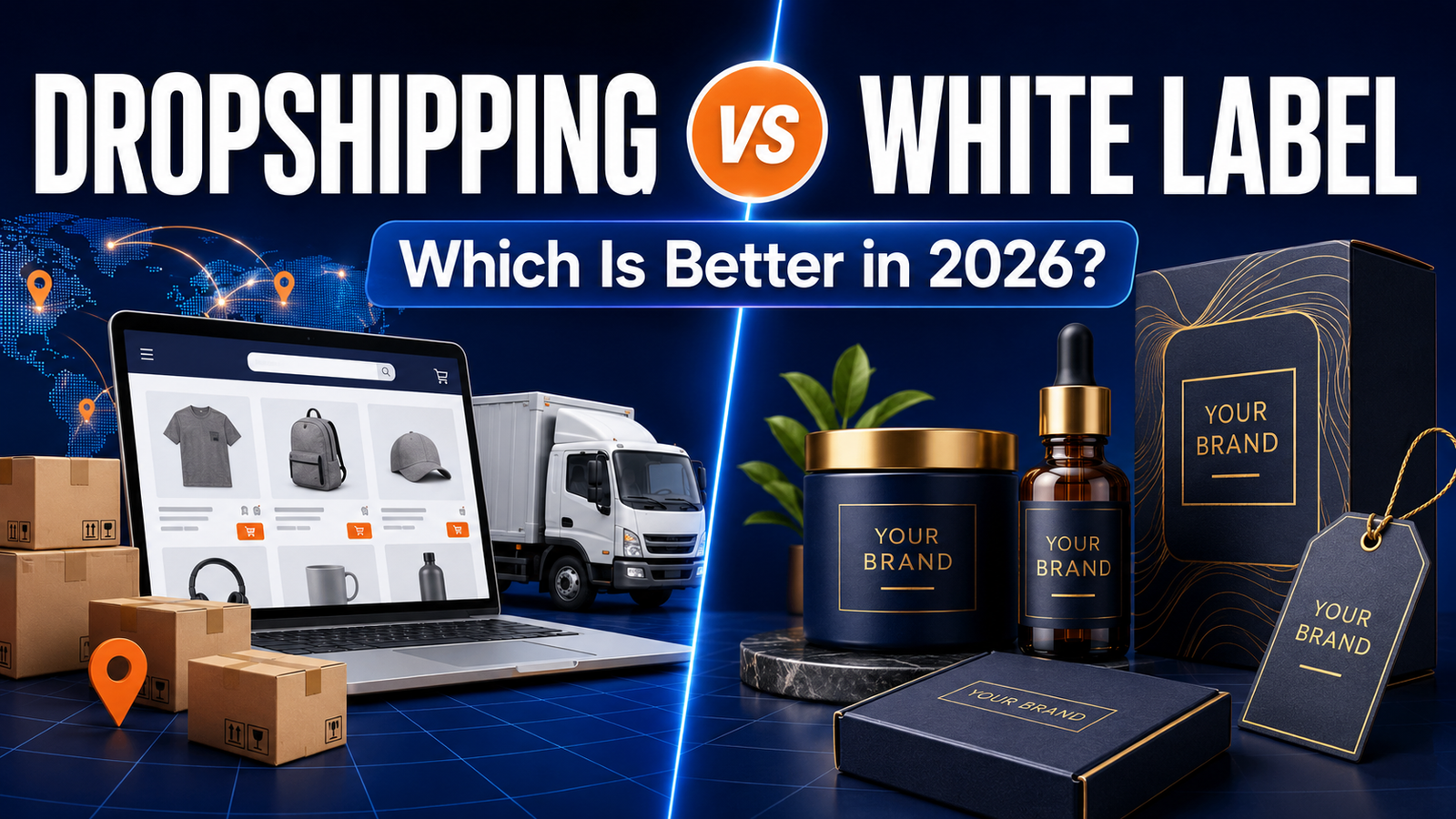
Ecommerce continues to create opportunities for entrepreneurs who want to sell products online without opening a traditional retail shop. However, choosing the right business model is one of the most important decisions you will make before launching your store.
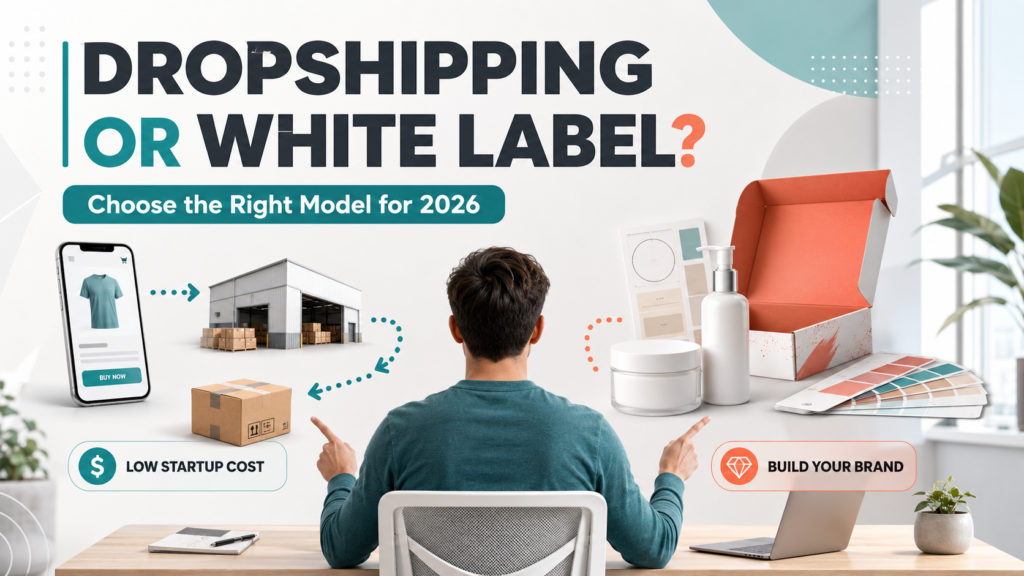
Two popular options are dropshipping and white label ecommerce. Both models allow you to sell products without manufacturing them from scratch, but they operate differently in terms of inventory, branding, investment, control, profit margins, and long-term growth.
Dropshipping is often considered easier for beginners because it requires less upfront investment. White labeling, on the other hand, offers stronger branding opportunities and greater control over the customer experience.
So, which business model is better in 2026?
This complete dropshipping vs white label comparison will explain how both models work, their advantages and disadvantages, and which option may be more suitable for your budget and business goals.
What Is Dropshipping?
Dropshipping is an ecommerce business model in which you sell products without keeping inventory in your own warehouse. When a customer places an order on your website, the order details are sent to a third-party supplier. The supplier then packages and ships the product directly to the customer.
You are responsible for building the online store, choosing products, setting prices, attracting customers, and providing customer support. The supplier handles inventory storage, packaging, and order fulfilment.
For example, you may create a Shopify store that sells home accessories, beauty products, electronics, or fashion items. When a customer purchases an item, you pay the supplier’s price and keep the difference between your selling price and the total product and fulfilment costs.
If you are new to this model, read this detailed guide on how to start dropshipping for free in 2026.
How Does Dropshipping Work?
A standard dropshipping process includes the following steps:
- You research a niche and identify potential products.
- You find a reliable supplier that offers dropshipping fulfilment.
- You create an ecommerce store and list the products.
- A customer places an order and pays through your website.
- You send the order information to the supplier.
- The supplier packages and ships the order directly to the customer.
- You earn the difference between your selling price and total expenses.
You do not need to purchase large quantities of inventory before making sales. This makes dropshipping attractive to beginners and people who want to test ecommerce products with relatively low financial risk.
Professional dropshipping store development services can help you connect product research, store design, supplier setup, payment methods, tracking, and marketing into one structured launch plan.
What Is a White Label Business?
White labeling is a business model in which a manufacturer creates a generic product that another company can sell under its own brand name.
The product may already be manufactured, tested, and ready for sale. You purchase it from the manufacturer and add your own logo, packaging, product name, and brand identity.
For example, a manufacturer may produce skincare serums, supplements, coffee, clothing, phone accessories, candles, or cleaning products. Several businesses can purchase the same basic item but sell it using their own branding and packaging.
The white label company does not usually manufacture the original product. Instead, it focuses on branding, marketing, distribution, and customer relationships.
How Does White Labeling Work?
A typical white label business works through these steps:
- You select a product category and target audience.
- You find a white label manufacturer or supplier.
- You request samples to check product quality.
- You create your brand name, logo, packaging, and positioning.
- You place an order based on the supplier’s minimum order quantity.
- The products are labelled and packaged under your brand.
- You store the inventory yourself or use a fulfilment partner.
- You promote and sell the products through your ecommerce store.
Some white label suppliers also provide fulfilment services. However, the business owner generally needs to invest in samples, packaging, inventory, product photography, and branding before launching.
Dropshipping vs White Label: Main Differences
Although both models help entrepreneurs avoid manufacturing products from the beginning, there are several important differences.
| Factor | Dropshipping | White Label |
|---|---|---|
| Initial investment | Usually low | Medium to high |
| Inventory | Supplier holds inventory | Brand usually purchases inventory |
| Branding control | Limited | Strong |
| Packaging | Usually supplier packaging | Custom branded packaging |
| Product control | Limited | More control |
| Speed to launch | Faster | Slower |
| Profit margins | Often lower | Potentially higher |
| Financial risk | Lower | Higher |
| Customer loyalty | More difficult to build | Easier with strong branding |
| Long-term brand value | Limited without differentiation | Stronger potential |
1. Startup Costs
Startup cost is one of the biggest differences between dropshipping and white labeling.
With dropshipping, you do not normally need to purchase products in bulk. Your main expenses may include a domain, ecommerce platform, store development, marketing creatives, product samples, and advertising.
A white label business usually requires more money upfront. You may need to pay for:
- Product samples
- Minimum order quantities
- Logo and brand identity
- Custom labels and packaging
- Product photography
- Inventory storage
- Shipping and fulfilment
- Website development
- Marketing campaigns
Dropshipping may therefore be more practical for someone with a limited budget. White labeling may suit entrepreneurs who have sufficient capital and want to build a recognizable brand.
2. Branding Opportunities
Branding is where white labeling has a significant advantage.
Many dropshipping stores sell products that customers can also find on other websites. Competitors may use the same supplier images, descriptions, features, and packaging. This makes differentiation difficult, especially when customers compare prices between several stores.
A white label business can create its own:
- Brand name
- Logo
- Product name
- Packaging design
- Brand story
- Product photography
- Website appearance
- Customer experience
Strong branding can make a commonly available product appear more distinctive and valuable. It can also help customers remember the company and return for future purchases.
3. Inventory and Fulfilment
In dropshipping, the supplier manages inventory and usually handles fulfilment. This reduces operational responsibilities, but it also means you depend heavily on the supplier.
If a product suddenly goes out of stock, you may have to pause advertisements, remove the listing, or offer an alternative. You also have limited control over packaging quality and dispatch time.
In white labeling, you usually purchase inventory in advance. This creates financial risk, but it gives you more control over stock levels, quality checks, packaging, and shipping.
The better option depends on whether you prioritize convenience or operational control.
4. Profit Margins
Dropshipping margins can be limited because you normally purchase each item individually from the supplier. Product cost, shipping fees, payment processing, platform charges, advertising costs, refunds, and returns can reduce your final profit.
White label products can provide higher margins when they are purchased in bulk at a lower per-unit cost. Strong branding may also allow you to charge a premium price.
However, higher potential margins do not guarantee profitability. You must still consider unsold inventory, storage charges, packaging, fulfilment, returns, and marketing expenses.
A business should calculate the complete landed cost of each product before setting its retail price.
5. Product Quality Control
In dropshipping, the supplier controls product quality and dispatch. You should order samples before listing a product, but the quality customers receive may still vary between batches.
Poor quality can result in negative reviews, refund requests, payment disputes, and damage to the store’s reputation.
White labeling provides better quality-control opportunities because you can inspect samples, communicate your packaging requirements, and sometimes request small adjustments. Nevertheless, you should still perform supplier checks and product testing before placing a large order.
6. Speed of Launch
Dropshipping is generally faster to launch. Once you have selected a supplier and product, you can build a store, prepare content, connect payment methods, and begin product testing.
White labeling takes more preparation. You need to finalize the product, approve samples, develop brand assets, design packaging, place an inventory order, and wait for manufacturing or labelling.
If your priority is to test an idea quickly, dropshipping offers greater flexibility. If you are focused on building a polished brand, the additional preparation required for white labeling may be worthwhile.
A professionally designed Shopify ecommerce store can support either model with mobile-friendly design, organized collections, optimized product pages, and a clear checkout journey.
Advantages of Dropshipping
The main benefits of dropshipping include:
- Lower initial investment
- No need to purchase bulk inventory
- Faster business launch
- Ability to test multiple products
- No personal warehouse required
- Flexible location and operations
- Easier entry for ecommerce beginners
- Lower risk from unsold stock
It can be a useful learning model because it allows beginners to understand product research, online store management, advertising, order processing, and customer service.
Disadvantages of Dropshipping
Dropshipping also comes with challenges:
- Lower control over product quality
- Limited packaging and branding options
- Supplier stock can change unexpectedly
- Delivery delays can affect customer satisfaction
- Many stores may sell the same products
- Profit margins can be relatively low
- Returns may be complicated
- Business performance depends on supplier reliability
Dropshipping is not automatic income. It requires product research, effective marketing, reliable fulfilment, strong customer support, and continuous store optimization.
Advantages of White Labeling
White labeling offers several long-term benefits:
- Products are sold under your own brand
- Greater control over packaging
- Better opportunity to build customer loyalty
- Potentially higher profit margins
- Stronger market differentiation
- More control over product presentation
- Possibility of premium pricing
- Greater long-term business value
A successful white label company can become an asset because customers recognize the brand rather than only the individual products.
Disadvantages of White Labeling
The main limitations include:
- Higher upfront investment
- Minimum order requirements
- Risk of unsold inventory
- Longer preparation and launch time
- Storage and fulfilment responsibilities
- More complex operations
- Packaging and branding expenses
- Greater financial exposure if the product fails
Proper market research is essential before investing in a large inventory order.
Which Model Is Better for Beginners?
Dropshipping is generally more suitable for beginners who have limited capital and want to learn ecommerce while keeping inventory risk low.
It provides an opportunity to test:
- Product demand
- Customer response
- Advertising creatives
- Pricing strategies
- Target markets
- Website conversion rates
Beginners who want structured, practical guidance can explore the Advanced Dropshipping Course by Marketo Solutions, which covers product research, Shopify setup, suppliers, Meta Ads, content, funnels, and launch planning.
However, beginners with existing industry knowledge, sufficient investment, and access to a trusted manufacturer may also start with white labeling.
Which Model Is Better for Long-Term Growth?
White labeling often offers stronger long-term brand potential because it gives the business more control over identity, packaging, product presentation, and customer relationships.
Nevertheless, dropshipping can also be used as the first stage of a long-term ecommerce strategy. A business can test several products through dropshipping, identify the best-performing item, and then convert that winning product into a white label brand.
This hybrid strategy can reduce risk. Instead of purchasing large quantities of an untested product, you validate customer demand first and invest in branding after gathering real sales data.
Dropshipping or White Label: How Should You Choose?
Choose dropshipping if:
- You have a limited startup budget.
- You want to launch quickly.
- You do not want to manage inventory.
- You want to test several products.
- You are still learning ecommerce.
- You prefer lower initial financial risk.
Choose white labeling if:
- You want to create a recognizable brand.
- You have enough capital for inventory.
- You want custom packaging and presentation.
- You understand your target market.
- You want better control over the customer experience.
- You are focused on long-term brand growth.
Before selecting either option, calculate your budget, assess supplier reliability, research customer demand, study competitors, and define your long-term goals.
Final Verdict
There is no single winner in the dropshipping vs white label debate. The right option depends on your experience, investment capacity, risk tolerance, and business objectives.
Dropshipping is better for testing products, starting with a smaller budget, and learning how ecommerce works. White labeling is better for building a distinctive brand, controlling the customer experience, and potentially achieving stronger margins over time.
For many new entrepreneurs, the smartest path in 2026 may be to start with dropshipping, collect genuine sales data, identify a winning product, and then develop it into a white label brand.
If you need support with product research, Shopify development, branding, supplier workflows, marketing, or business launch planning, explore the complete dropshipping business solutions offered by Marketo Solutions.
Frequently Asked Questions
Is white label the same as dropshipping?
No. Dropshipping is a fulfilment model in which the supplier ships products directly to customers. White labeling is a branding model in which an existing product is sold under your own brand name. A supplier can sometimes offer both white labeling and dropshipping fulfilment.
Is white labeling more profitable than dropshipping?
White labeling can provide better profit margins because products are often purchased in bulk and sold with stronger branding. However, it also requires more investment and carries the risk of unsold inventory.
Can I turn a dropshipping product into a white label product?
Yes. You can test demand through dropshipping and later find a manufacturer that offers private packaging or white label services. This can be an effective way to build a brand around a product that has already generated sales.
Do I need Shopify for these business models?
Shopify is a popular option, but it is not the only choice. You can also use WooCommerce or another ecommerce platform. The best solution depends on your budget, required features, technical knowledge, and growth plans.
Can I run a white label business without storing products myself?
Yes. You can use a third-party logistics provider or work with a manufacturer that offers storage and fulfilment. However, you must carefully compare storage, packaging, shipping, and order-processing charges.