
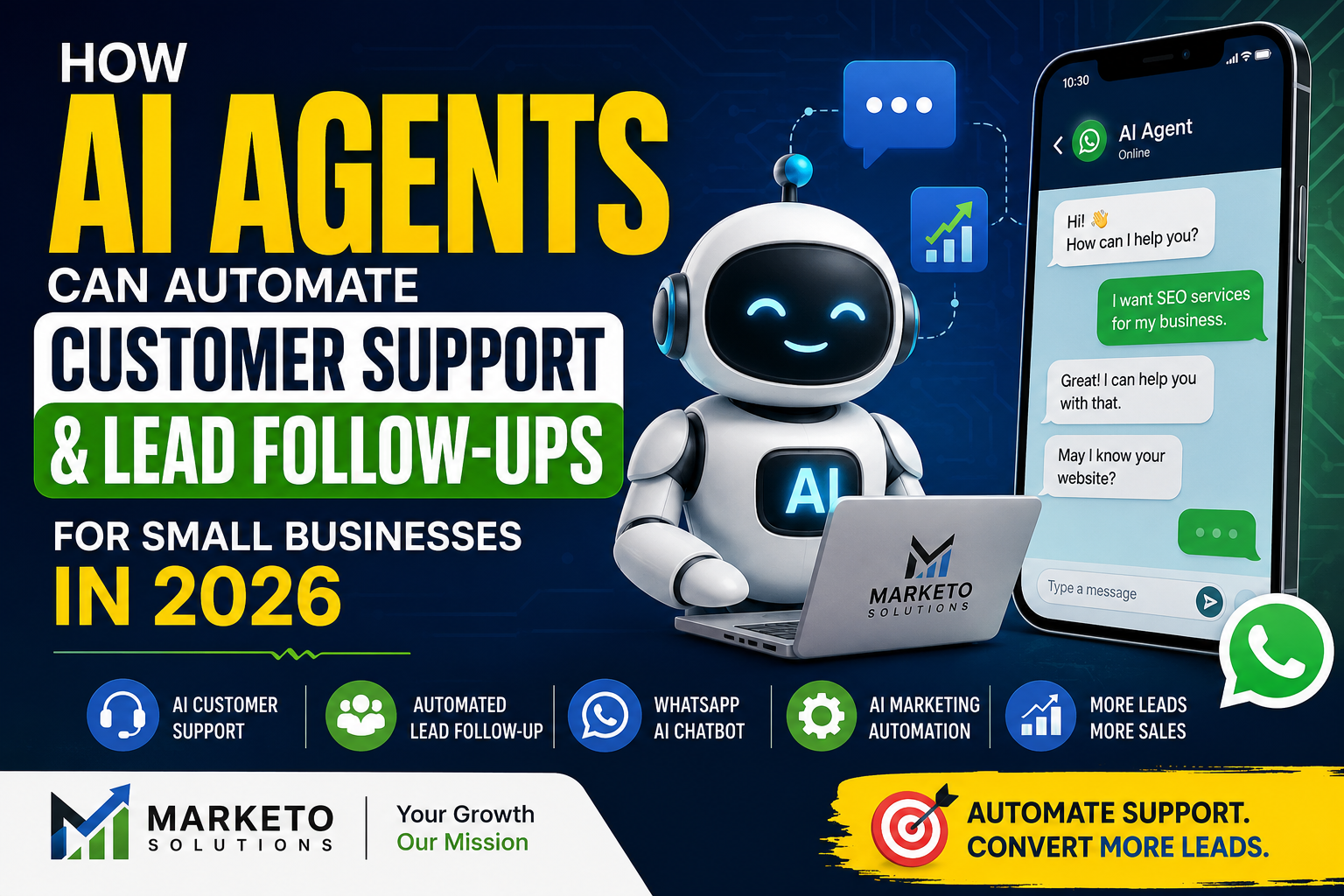
Small businesses often lose potential customers for a simple reason: they do not respond quickly enough. A customer sends a message on WhatsApp, submits a website form, comments on an Instagram ad, or asks about a service after office hours—but nobody follows up at the right time.
This is where AI agents for small businesses can help. An AI agent can answer common questions, collect customer details, qualify leads, schedule follow-up messages, update a CRM, and transfer important conversations to a human team member.
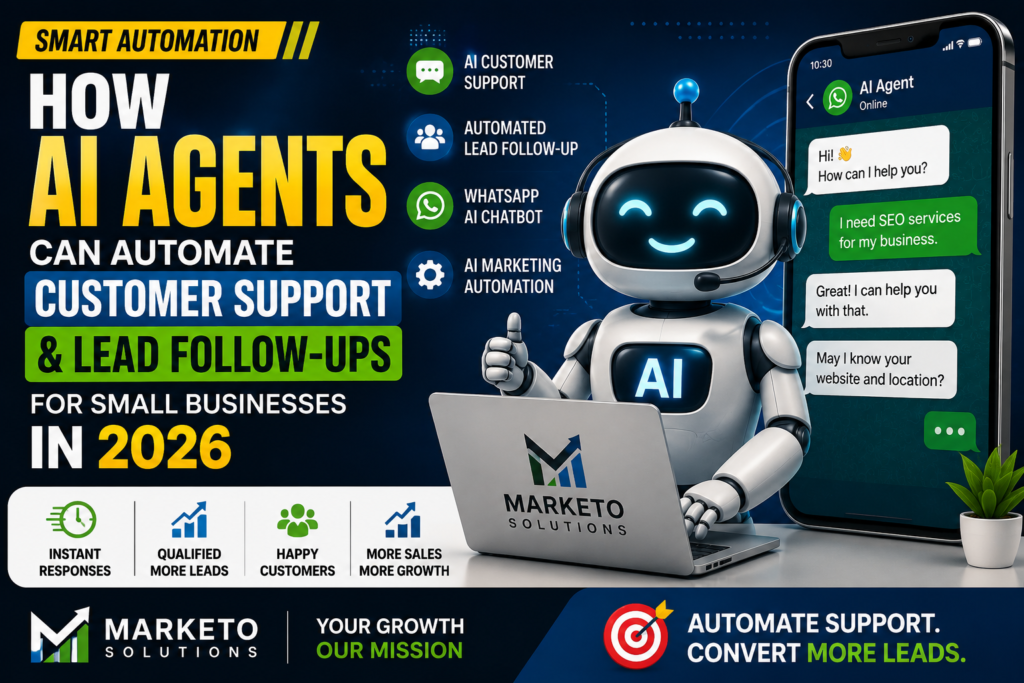
The goal is not to remove humans from customer service. The goal is to reduce repetitive work, respond faster, and make sure valuable inquiries do not disappear inside an inbox.
What Are AI Agents for Small Businesses?
An AI agent is more advanced than a basic chatbot. A traditional chatbot normally follows fixed questions and answers. An AI agent can understand a customer’s request, use available business information, perform multiple connected actions, and decide when a conversation needs human attention.
Modern AI agents can plan tasks, connect with external tools, and complete multi-step workflows with less manual involvement. However, responsible deployment still requires clear limits, monitoring, and meaningful human control.
For example, a potential customer may send this message:
“I need SEO services for my clinic in Lahore. What is the price and how long will it take?”
A properly configured AI agent could:
- Identify that the person is interested in SEO
- Ask about the clinic’s website and target location
- Collect the customer’s name and phone number
- Explain the consultation process
- Save the inquiry in a lead sheet or CRM
- Notify the sales team
- Schedule a follow-up if the customer stops responding
This is different from sending the same automatic reply to every person.
Why AI Agents for Small Businesses Matter in 2026
Small business AI adoption has continued to increase as companies look for practical ways to improve productivity without immediately expanding their teams. Research published in 2026 also shows that businesses are adopting AI at earlier stages of their development than before.
The biggest advantage is not simply “using AI.” The real advantage is creating a better response and follow-up system.
Many small businesses currently face these problems:
- Customer messages remain unanswered after working hours
- Leads from Meta Ads are contacted too late
- Staff repeatedly answer the same questions
- Customer details are stored in different places
- Follow-up depends on someone remembering it
- Sales teams spend time speaking to unqualified leads
- Customers receive inconsistent information
- Business owners cannot track which lead source is working
AI marketing automation can connect these activities into one organized workflow.
How AI Can Automate Customer Support
1. Answer Frequently Asked Questions
An AI customer support agent can handle common questions about:
- Service prices
- Product availability
- Delivery times
- Business hours
- Office location
- Payment methods
- Appointment availability
- Return or refund policies
- Service areas
- Package details
The answers should come from approved business information rather than unrestricted internet content. This reduces the risk of the agent providing incorrect prices, policies, or promises.
2. Provide Support Outside Office Hours
A customer may contact a business at 11:00 p.m. after seeing an advertisement. Waiting until the next morning can reduce the chances of conversion, especially when the customer is contacting multiple companies.
An AI agent can immediately confirm that the inquiry has been received, answer basic questions, collect essential details, and inform the customer when a human representative will become available.
3. Categorize Customer Requests
Not every message has the same urgency. An AI agent can categorize conversations as:
- New sales lead
- Existing customer support
- Complaint
- Order-status request
- Appointment request
- Partnership inquiry
- Job application
- Spam or irrelevant message
The correct department can then receive the conversation instead of every message going into one general inbox.
4. Create Support Tickets and Summaries
Long conversations take time to review. An AI agent can create a short summary containing the customer’s problem, previous steps, contact information, and required action.
Research on customer-service AI shows that well-designed systems can improve service speed and make agent communication more informative. However, performance depends heavily on implementation, testing, and how the human team uses the system.
How Automated Lead Follow-Up Works
Generating a lead is only the first step. A business still needs to contact, qualify, nurture, and convert that lead.
A practical automated lead follow-up workflow may look like this:
- A customer submits a Meta lead form.
- The lead enters a CRM or connected spreadsheet.
- A WhatsApp message is sent immediately.
- The AI agent asks two or three qualifying questions.
- The lead is categorized as high, medium, or low intent.
- A salesperson is notified about qualified leads.
- A reminder is sent if the customer does not reply.
- The sales team receives a summary before taking over.
This process can be connected with website forms, Google Ads landing pages, Meta Ads, social media messages, and ecommerce inquiries.
Businesses already investing in lead generation campaigns should focus on follow-up speed as well as cost per lead. A cheap lead is not valuable if nobody responds professionally.
WhatsApp AI Chatbot for Pakistani Businesses
For many Pakistani service providers, ecommerce stores, clinics, institutes, property businesses, agencies, and local companies, WhatsApp is an important customer communication channel.
A WhatsApp AI chatbot can help businesses manage:
- New customer inquiries
- Product recommendations
- Appointment requests
- Service quotations
- Order updates
- Abandoned inquiries
- Payment reminders
- Post-purchase support
- Feedback requests
- Sales-team handovers
Meta describes the WhatsApp Business Platform as a business messaging system that can support customer engagement, lead generation, conversational commerce, and marketing workflows. Businesses should use the official platform and approved messaging practices rather than unofficial bulk-messaging systems.
An AI chatbot should also clearly identify when a message is automated. Customers should always have an easy way to request human assistance.
A Practical AI Agent Setup for Small Businesses
Business owners should not automate everything at once. Start with one specific problem.
Step 1: Select One Workflow
Good starting points include:
- Answering website FAQs
- Responding to WhatsApp inquiries
- Following up with Meta Ads leads
- Booking appointments
- Collecting quotation requirements
- Sending order-status updates
Step 2: Prepare Accurate Business Information
The AI agent needs a reliable knowledge base containing:
- Services and products
- Current pricing
- Service locations
- Business hours
- Delivery information
- Refund policies
- Frequently asked questions
- Approved offers
- Escalation rules
- Contact information
Incorrect or outdated information will result in poor customer experiences.
Step 3: Define Human Handover Rules
An AI agent should transfer the conversation when:
- The customer asks for a human
- A complaint becomes serious
- The customer requests a custom quotation
- Payment or account information is involved
- The agent is uncertain
- The customer becomes frustrated
- A high-value lead is identified
Step 4: Connect the Required Platforms
Depending on the business, the agent may connect with:
- Website live chat
- WhatsApp Business Platform
- Meta lead forms
- Customer relationship management software
- Google Sheets
- Appointment calendar
- Shopify or WordPress
- Helpdesk software
Step 5: Test Before Full Launch
Test the system with real customer questions, spelling mistakes, Roman Urdu, incomplete messages, unusual requests, and negative feedback.
Do not test only perfect questions such as “What are your working hours?” Test messages like:
“price kia hy aur lahore may delivery kab ho ge?”
The system should understand the intent without inventing information.
Where Human Customer Support Is Still Necessary
AI agents work well for repetitive and structured tasks, but they should not control every conversation.
Human assistance remains important for:
- Complex complaints
- Sensitive customer situations
- Negotiations
- High-value sales
- Customized services
- Refund disputes
- Strategic consultation
- Unclear customer requirements
- Decisions requiring professional judgment
The best system combines AI speed with human understanding. AI handles the first response, information collection, categorization, and reminders. Humans handle trust, judgment, negotiation, and relationship building.
Connecting AI Agents with SEO, Ads and Website Growth
AI automation works better when the rest of the digital journey is properly built.
SEO and Website Traffic
An AI agent cannot compensate for a website that receives no relevant visitors. Businesses still need keyword research, helpful content, technical improvements, local SEO, and conversion-focused pages.
Companies targeting long-term visibility can connect automation with professional SEO services in Lahore. Marketo’s guide on choosing the best SEO expert in Lahore also explains what businesses should examine before selecting an SEO partner.
Google Ads and Meta Ads
Paid advertising can generate inquiries quickly, while AI agents can help process and follow up with those inquiries.
A complete campaign should connect:
- Relevant ad targeting
- Strong creative content
- Conversion-focused landing page
- Lead form or WhatsApp button
- Immediate response
- Qualification questions
- Human sales follow-up
- Conversion tracking
Businesses can read this guide on choosing a digital marketing agency in Lahore for SEO, ads and lead generation to understand how these channels work together.
Google Business Profile
Local businesses receive calls, website visits, direction requests, and messages through Google Search and Maps. Business information must be accurate before an AI agent uses it.
Businesses facing listing problems can review this guide on how to fix a failed Google Business Profile verification.
Ecommerce Marketing
An ecommerce AI agent can answer product questions, recommend relevant items, explain delivery policies, and guide customers towards checkout. However, automation will not solve poor product pages, confusing pricing, weak trust signals, or checkout problems.
Store owners receiving visitors but no orders should first understand why an ecommerce store has traffic but no sales.
How to Choose AI Agent Services in Pakistan
Before hiring a provider, ask these questions:
- Will the system use our approved business information?
- Can it understand English and Roman Urdu?
- Does it support human handover?
- Can it connect with WhatsApp and our website?
- How will customer data be protected?
- Can conversations be reviewed?
- Will we receive lead and performance reports?
- What happens when the agent does not know an answer?
- Can workflows be changed later?
- Are official APIs being used?
Avoid providers that promise complete automation without understanding your customer journey. A useful AI system should match your business model, team capacity, sales process, and communication style.
How Marketo Solutions Can Help
Marketo Solutions helps businesses create connected digital growth systems rather than treating every marketing channel separately.
Depending on the business requirements, the strategy may include:
- Website and landing-page improvement
- SEO and local search optimization
- Google Ads and Meta Ads management
- Lead-generation workflows
- WhatsApp inquiry management
- Customer-support automation
- WordPress website development
- Shopify store development
- Google Business Profile optimization
- Social media marketing
- Conversion tracking and reporting
You can learn more about the company’s approach on the Marketo Solutions homepage, review its digital marketing services, or learn more about Marketo Solutions.
Conclusion
AI agents for small businesses can reduce missed inquiries, improve response times, organize customer conversations, and automate lead follow-ups. Their real value comes from connecting customer support, WhatsApp, websites, paid campaigns, and sales teams into one manageable system.
However, businesses should begin with a specific workflow, use accurate information, establish human handover rules, and regularly review conversations. AI should support your team—not make uncontrolled decisions on its behalf.
For a practical strategy covering AI automation, SEO, paid advertising, websites, and lead generation, contact Marketo Solutions and discuss the areas where your business is currently losing inquiries or sales.
FAQs
1. What are AI agents for small businesses?
AI agents are software systems that can understand customer requests, use approved business information, perform connected tasks, and complete actions such as answering questions, collecting lead details, scheduling follow-ups, or transferring conversations to staff.
2. Can an AI agent automatically follow up with leads?
Yes. An AI agent can respond after a website form or ad submission, ask qualifying questions, send reminders, update lead records, and notify a salesperson. Follow-ups should follow customer consent and platform messaging rules.
3. Can a WhatsApp AI chatbot understand Roman Urdu?
A properly configured system can understand many common English, Urdu, and Roman Urdu messages. It should still be tested using real customer language and transfer unclear conversations to a human representative.
4. Will AI agents replace customer-support employees?
AI agents are better suited to repetitive questions, first responses, data collection, conversation summaries, and reminders. Human employees remain necessary for complaints, negotiations, sensitive issues, and complex sales decisions.
5. How much does an AI agent cost for a small business in Pakistan?
The cost depends on the number of conversations, connected platforms, workflow complexity, AI usage, integrations, and support requirements. Businesses should start with one high-value workflow before investing in a larger automation system.