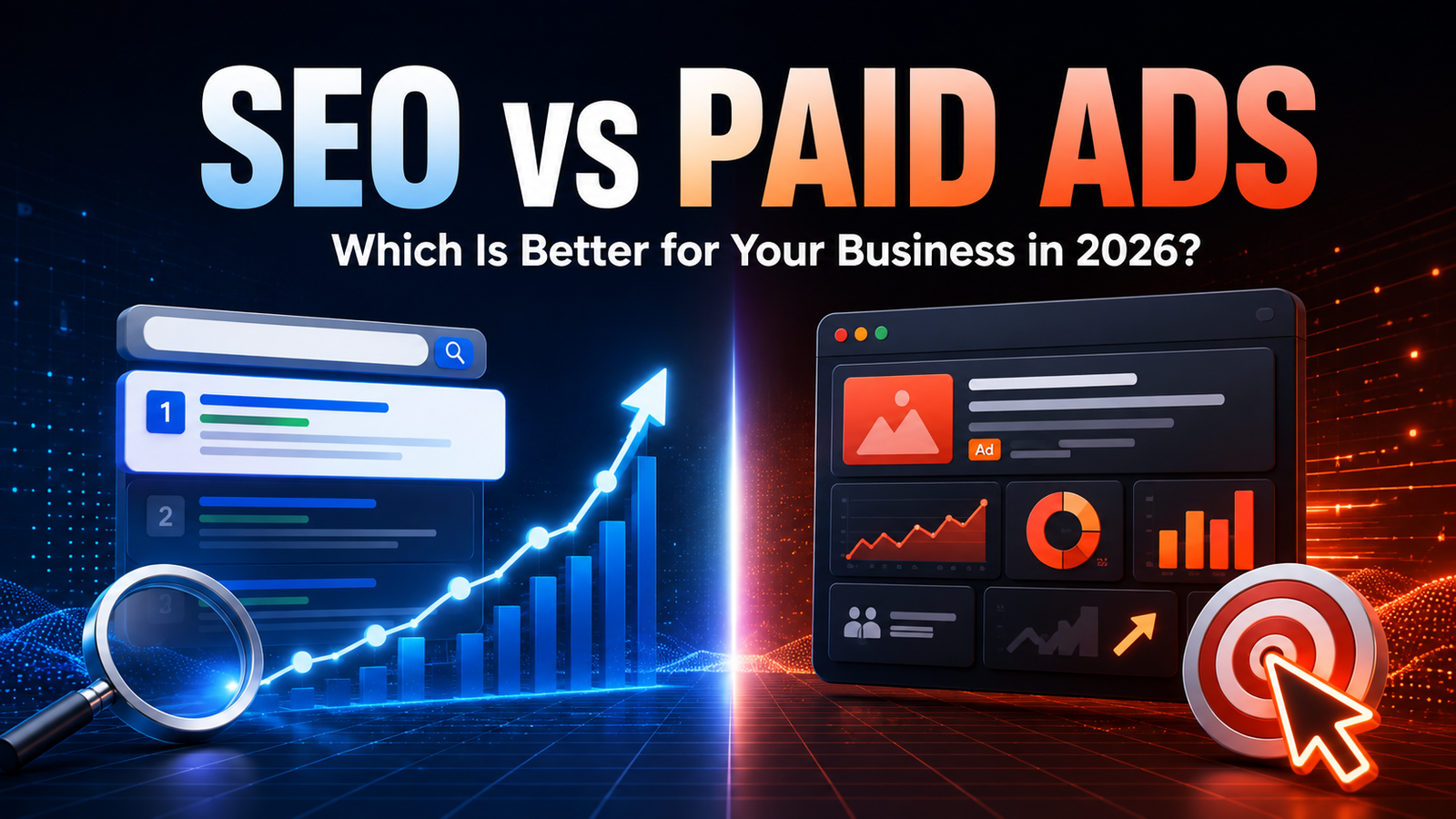
Businesses investing in digital marketing frequently face the same question: should they focus on SEO or spend their budget on paid advertising?
Both SEO and paid ads can attract website visitors, generate leads and increase sales. However, they achieve these results in very different ways. SEO builds organic visibility over time, while paid advertising provides immediate access to a targeted audience in exchange for advertising spend.
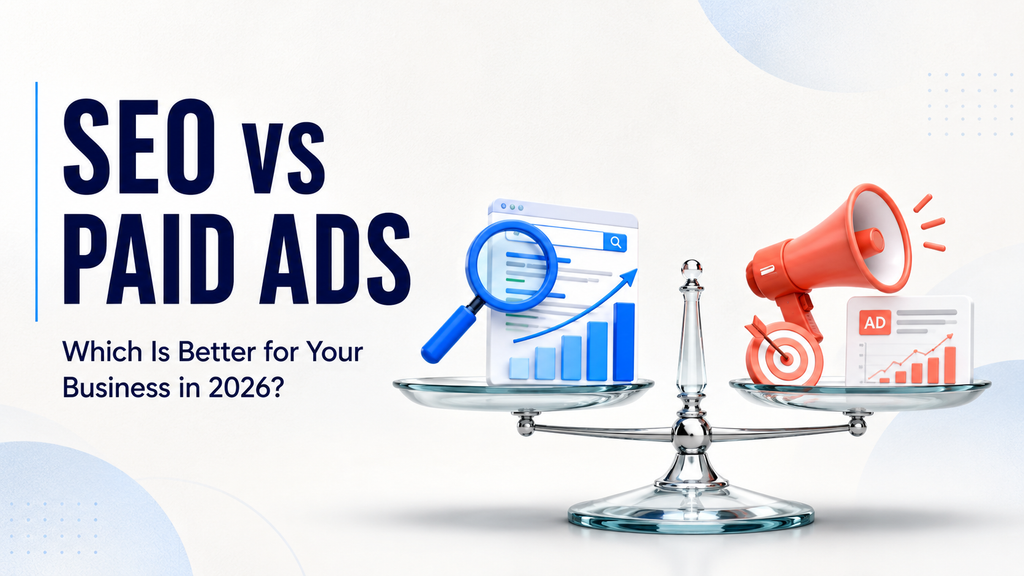
The best option depends on your business goals, available budget, level of competition and how quickly you need results. A new business may need paid ads to generate immediate inquiries, while an established company may use SEO to reduce its dependence on advertising and build a sustainable source of traffic.
In many cases, the strongest strategy is not choosing one channel and ignoring the other. Businesses can use paid ads for immediate demand while investing in SEO for long-term growth.
This guide explains the difference between SEO and paid ads, their advantages, costs, limitations and ideal use cases to help you make the right decision in 2026.
What Is SEO?
Search engine optimization, commonly known as SEO, is the process of improving a website so that it can appear prominently in the unpaid results of Google and other search engines.
When customers search for services, products or answers related to your business, SEO helps search engines understand your website and determine whether its content is relevant and trustworthy.
A complete SEO strategy may include:
- Keyword research
- On-page optimization
- Technical SEO
- Content creation
- Internal linking
- Website speed improvements
- Backlink building
- Local SEO
- Google Business Profile optimization
- Search performance monitoring
For example, a digital agency may optimize its website for phrases such as “SEO services in Lahore,” “digital marketing agency in Pakistan” or “website development company.” If the website earns strong organic rankings, it can receive visitors without paying Google for every click.
Businesses that want to develop sustainable organic visibility can explore the professional SEO services offered by Marketo Solutions.
What Are Paid Ads?
Paid advertising allows businesses to display promotional messages across search engines, social media platforms, websites and mobile applications by paying for impressions, clicks, leads or conversions.
Popular paid advertising platforms include:
- Google Search Ads
- Google Shopping Ads
- Google Performance Max
- Facebook Ads
- Instagram Ads
- TikTok Ads
- YouTube Ads
- LinkedIn Ads
Google Ads usually captures users who are already searching for a solution. Meta and TikTok ads can create demand by introducing products or services to targeted audiences based on their interests, demographics and online behaviour.
Paid ads can begin generating traffic shortly after a campaign is approved. However, the business must continue funding the campaign to maintain visibility.
Marketo Solutions provides connected digital marketing and paid advertising services covering Google Ads, Meta Ads, TikTok advertising, ecommerce campaigns, retargeting and lead generation.
SEO vs Paid Ads: The Main Difference
The main difference between SEO and paid ads is how website visibility is achieved.
SEO helps a website earn visibility in organic search results by improving content quality, technical performance, authority and relevance. Paid ads allow a business to purchase visibility for selected audiences, keywords or placements.
| Factor | SEO | Paid Ads |
|---|---|---|
| Visibility | Earned organically | Purchased through advertising |
| Speed | Usually requires time | Can generate traffic quickly |
| Cost model | Investment in optimization | Payment for clicks, impressions or conversions |
| Duration | Can continue producing traffic | Visibility usually stops when campaigns stop |
| Trust | Organic results may build credibility | Clearly displayed as sponsored content |
| Targeting | Based mainly on search intent and relevance | Detailed audience, keyword and placement targeting |
| Testing | Requires more time and content | Campaigns and offers can be tested quickly |
| Long-term value | Can build a sustainable traffic asset | Provides fast but budget-dependent results |
How Long Does SEO Take to Produce Results?
SEO is a long-term strategy. A website may require several months to achieve meaningful improvement, depending on its current condition, competition, domain history, content quality and authority.
A new website operating in a competitive industry may take longer to rank than an established website targeting less competitive searches. Technical problems, thin content and weak backlinks can also delay progress.
SEO should not be treated as a one-time activity. Search behaviour changes, competitors publish new content and Google continues updating its systems. Businesses must regularly improve their website, update important pages and publish helpful content.
Although SEO requires patience, a well-ranked page can continue attracting relevant visitors after its initial publication. That makes SEO valuable for businesses looking to build a long-term source of leads and traffic.
How Quickly Can Paid Ads Generate Results?
Paid ads can begin generating impressions, clicks and inquiries soon after a campaign is launched and approved. This makes advertising useful for businesses that need immediate visibility.
However, launching an ad does not automatically guarantee profitable results. Campaign performance depends on several factors:
- Campaign objective
- Audience selection
- Keyword targeting
- Ad creative
- Offer quality
- Landing-page experience
- Conversion tracking
- Budget allocation
- Lead follow-up
- Ongoing optimization
A campaign can generate clicks without generating customers if the landing page is slow, the offer is unclear or the audience is poorly targeted. A conversion-focused website is therefore essential for both SEO and paid advertising. Businesses experiencing website problems can review Marketo Solutions’ website development services for WordPress, Shopify and ecommerce projects.
Which Option Costs More?
The cost of SEO and paid ads cannot be compared using advertising spend alone.
SEO does not require payment for every organic click, but professional SEO still requires investment. Businesses may need to pay for keyword research, technical improvements, content development, link building, SEO tools and ongoing management.
Paid advertising requires direct platform spending in addition to campaign management, creative production, tracking and landing-page optimization.
The actual cost of both strategies depends on:
- Industry competition
- Target market
- Business objectives
- Keyword costs
- Content requirements
- Website condition
- Campaign scale
- Customer acquisition cost
Paid ads may initially look more expensive because the advertising spend is visible. SEO costs can appear lower, but a competitive campaign still requires consistent investment.
The right question is not simply, “Which channel costs less?” Businesses should ask, “Which channel delivers qualified leads and profitable customers at an acceptable cost?”
Benefits of SEO for Businesses
1. Sustainable Organic Traffic
Strong search rankings can attract visitors continuously without charging the business for each individual click.
2. Increased Trust and Authority
Helpful content, detailed service pages, reviews and strong organic visibility can make a business appear more credible to potential customers.
3. Better Long-Term Value
SEO creates digital assets such as optimized service pages, guides, case studies and location pages that can continue supporting business growth.
4. Visibility Across the Customer Journey
SEO can target informational, commercial and transactional searches. A business can reach users who are researching a problem as well as customers ready to make a purchase.
5. Improved Website Quality
Technical SEO and on-page optimization can improve navigation, mobile usability, page speed and content structure, benefiting visitors from every marketing channel.
Limitations of SEO
SEO also has limitations that businesses must understand:
- Results are not immediate.
- Competitive keywords require substantial effort.
- Rankings can fluctuate.
- Content needs regular improvement.
- Backlinks and authority take time to develop.
- Poor technical performance can restrict progress.
SEO is most effective when businesses view it as a consistent growth investment rather than a quick ranking trick.
Benefits of Paid Advertising
1. Immediate Visibility
Paid ads allow a business to appear in front of potential customers without waiting months for organic rankings.
2. Detailed Targeting
Campaigns can target audiences based on keywords, location, interests, demographics, website activity and previous engagement.
3. Fast Testing
Businesses can quickly test multiple offers, headlines, visuals, landing pages and audience groups.
4. Scalable Campaigns
When a campaign generates profitable results, the business may be able to increase its budget and reach more potential customers.
5. Measurable Performance
Advertising platforms provide data related to impressions, clicks, leads, purchases, conversion rates and advertising costs. Correct tracking is essential for evaluating real performance.
Examples of Marketo Solutions’ SEO, advertising, website and branding work are available in the agency’s digital marketing portfolio.
Limitations of Paid Ads
Paid advertising also carries certain risks:
- Traffic can decline when the campaign is paused.
- Competitive keywords may be expensive.
- Poor targeting can waste the budget.
- Campaigns require regular testing and optimization.
- Weak creative can reduce performance.
- Incorrect tracking can produce misleading reports.
- Advertising cannot compensate for a weak product or offer.
Businesses should avoid increasing budgets before confirming that their targeting, landing page, offer, conversion tracking and follow-up process are working properly.
When Should You Choose SEO?
SEO may be the better priority when:
- You want sustainable organic traffic.
- Your customers actively search for your services.
- You can wait for gradual results.
- You want to build online authority.
- You have useful expertise that can be converted into content.
- You want to reduce long-term reliance on advertising.
- Your business operates in a market with consistent search demand.
SEO is especially valuable for professional services, local businesses, educational websites, ecommerce stores and companies offering solutions that customers regularly research online.
When Should You Choose Paid Ads?
Paid advertising may be more suitable when:
- You need leads or sales quickly.
- You are launching a new offer.
- You want to test market demand.
- You are promoting a limited-time campaign.
- Your website does not yet rank organically.
- You have a clear offer and conversion-ready landing page.
- You can track lead quality and customer acquisition costs.
- You want to retarget previous website visitors.
Paid ads are particularly effective for product launches, seasonal promotions, ecommerce sales, event registrations and high-intent lead-generation campaigns.
SEO and Paid Ads Work Better Together
For many businesses, combining SEO with paid advertising delivers a more balanced growth strategy.
Paid ads can generate immediate data about the keywords, offers and messages that attract customers. These insights can then support SEO content planning. Meanwhile, SEO can build long-term organic visibility and reduce dependence on paid traffic.
A combined strategy may work like this:
- Launch Google or Meta Ads to generate immediate traffic.
- Identify the best-performing keywords and offers.
- Create SEO landing pages and helpful content around proven customer needs.
- Retarget organic website visitors through paid campaigns.
- Improve the landing page using data from both channels.
- Track leads, sales and customer acquisition costs across the complete funnel.
Instead of treating SEO and paid ads as competing departments, businesses should use them as connected parts of one customer acquisition strategy.
Which Is Better for Small Businesses?
A small business with a limited budget should select the channel that best matches its immediate objective.
If the business urgently needs inquiries and has a strong landing page, paid ads may provide faster opportunities. If it can invest consistently and wait for gradual growth, SEO may create better long-term value.
A practical approach is to begin with a controlled advertising budget while building the SEO foundation. This allows the business to test demand today without ignoring future organic growth.
The budget should not be divided equally without a reason. Allocation should depend on search demand, customer value, sales cycle, competition and the business’s ability to follow up with leads.
Final Verdict: SEO or Paid Ads?
SEO is generally better for building long-term organic visibility, trust and sustainable website traffic. Paid advertising is generally better for immediate reach, faster testing and short-term lead generation.
Neither channel is automatically better for every business.
Choose SEO when you want to build a durable search presence and can invest consistently over time. Choose paid ads when speed, testing and targeted reach are the primary goals. Use both when you want immediate customer acquisition supported by a long-term organic growth strategy.
Marketo Solutions connects SEO, Google Ads, Meta Ads, website development and conversion strategy around measurable business goals. If you are unsure where to invest your marketing budget, contact Marketo Solutions for a strategy based on your current website, market, competition and growth objectives.
Frequently Asked Questions
Is SEO better than paid advertising?
SEO is better for long-term organic growth, while paid advertising is better for immediate visibility. The best choice depends on your budget, timeline and business objectives.
Is SEO free?
SEO traffic does not require payment for every click, but SEO itself is not free. It requires investment in content, technical optimization, tools, website improvements and authority building.
Do paid ads improve SEO rankings?
Paid ads do not directly improve organic rankings. However, advertising can increase brand visibility, generate data and attract users who may later search for the brand organically.
Should a new business start with SEO or paid ads?
A new business can use paid ads for immediate visibility while simultaneously developing its SEO foundation. This provides short-term data and supports sustainable long-term growth.
Can SEO and paid ads target the same keywords?
Yes. Targeting the same important keywords through organic SEO and paid search can increase overall search visibility. Performance data should determine whether using both channels is financially worthwhile.
What happens when paid advertising stops?
When paid campaigns stop, their impressions and clicks usually stop as well. SEO pages can continue generating traffic, although rankings still require monitoring and ongoing maintenance.
How can I measure SEO and paid ad performance?
SEO can be measured using organic traffic, rankings, conversions and qualified leads. Paid campaigns can be measured through cost per click, cost per lead, conversion rate, customer acquisition cost and return on advertising spend.